
Open-Sourced K-MAPS
A lightweight JavaScript library for visualizing King Safety, Material, Activity, Pawn Structure, and SpaceWhile working on the Chessboard Magic Repertoire Builder, a fellow chess enthusiast @mattchessic mentioned that it would be great to have something called K-MAPS to help visualize and refine one’s repertoire.
At the time, I had no idea what K-MAPS were — but the concept intrigued me: a simple, visual way to assess a chess position across key strategic dimensions. Naturally, I did what any developer would do — I went searching for an existing library.
To my surprise, there wasn’t one. So, with help from the Chess Programming Wiki, some late-night AI assistance, and more than a few long coding sessions, I decided to put something together.
TLDR: GitHub Repository: https://github.com/HollowLeaf1981/chess-kmaps
What Are K-MAPS?
K-MAPS (King, Material, Activity, Pawn Structure, Space) is a conceptual framework that breaks down a chess position into five fundamental strategic factors:
- King Safety — How exposed or protected each king is.
- Material — The relative balance of pieces.
- Activity — The mobility and coordination of your forces.
- Pawn Structure — The health and formation of your pawns.
- Space — The territorial control and influence across the board.
The goal is to express a position’s strategic balance numerically — and visually — making it easier to spot imbalances, strengths, and weaknesses at a glance.
The Rabbit Hole
The first step was research — reading through the various mathematical approaches and evaluation formulas used in chess engines and theory, to understand what an implementation might look like.
However, I quickly discovered there wasn’t a definitive definition or set of algorithms for K-MAPS anywhere — at least not in a form that could be directly implemented. So, I took a best-guess approach: studying how each factor might be quantified and how those metrics could interact in a balanced way.
Next came the design. I wanted the package to be simple — just one function that takes a FEN and returns normalized scores for White and Black.
To achieve this, I relied on chess.js for basic board manipulation, while the rest would be pure logic — identifying positional attributes, computing ratios, and developing a weighting system to blend them into five unified K-MAPS metrics.
Then came the coding. I built the initial version from scratch, guided by notes, intuition, and plenty of trial and error. Once it worked, I ran the entire library through multiple AIs — ChatGPT, Grok, and Gemini — to identify possible improvements, missed conditions, or edge cases I hadn’t considered. Each iteration brought refinements until it became a stable, modular, and surprisingly robust little library.
I’m an amateur programmer at best, and with the number of algorithms and calculations involved, I’ve most definitely missed something — but that’s part of the fun. The project is open so others can explore, improve, and build on it.
The Result
The result is Chess K-MAPS — an open-source, MIT-licensed JavaScript library that evaluates a position and returns normalized scores for the five core factors.
It also includes a simple demo app so you can plug in your own positions and see how each metric shifts as the board evolves.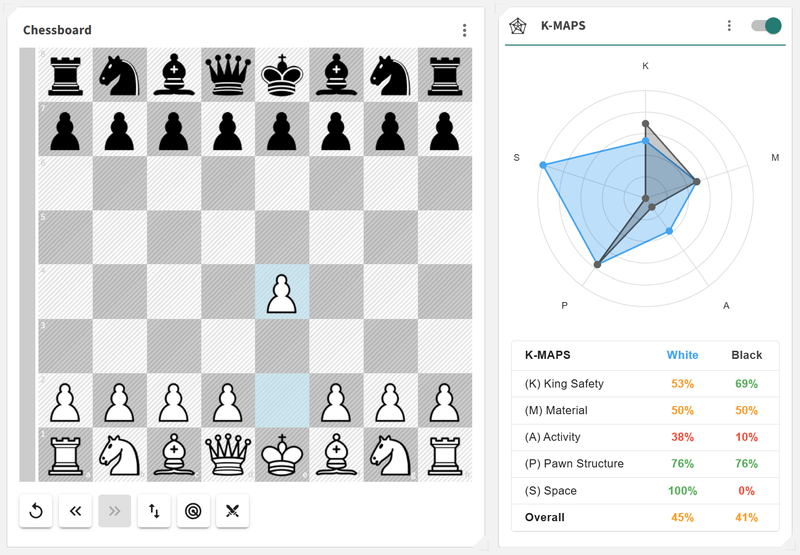
Image from the Chessboard Magic Repertoire Builder
It’s still a basic implementation — a foundation rather than a finished tool — but I’m hoping others in the chess and dev community will pick it up, refine it, and expand upon it. For now, it’s a simple function that takes a FEN and returns the output — clear, direct, and ready to experiment with.
GitHub Repository: https://github.com/HollowLeaf1981/chess-kmaps
Do let me know what you think — and if you end up using this in your own chess products, I’d love to hear about it.
Kind Regards,
Toan Hoang (@HollowLeaf)
You may also like
 CM HGabor
How titled players lie to you
This post is a word of warning for the average club player. As the chess world is becoming increasin… HollowLeaf
AI Chess Coaches?
Is It Possible? HollowLeaf
In Search of Brilliancies in Chess
!! HollowLeaf
Building Chess Solitaire
Exploring the design, analysis, and results behind my latest chess application ChessMonitor_Stats
Engine-Powered Opening Explorer
Opening explorers show what’s popular. Engine shows what’s best. What if we combine both? HollowLeaf