
https://mychessposters.com/shop/italian-game-chess-poster/
Visualizing the Italian Game: A Data-Driven Decision Tree Approach

This article is adapted from my visual analysis on MyChessPosters.com. All statistics are derived from the Lichess Opening Explorer database between January 2017 and December 2024.
You've probably studied the Italian Game by reading move sequences: 1.e4 e5 2.Nf3 Nc6 3.Bc4... But have you ever tried to see the opening as a connected structure? This guide takes a different approach: instead of memorizing notation, we'll explore the Italian Game through visual decision trees backed by real Lichess data.
The goal is simple: understand not just WHAT to play, but WHY each branch leads where it does—and which moves actually win games at your rating level.
How Visual Decision Trees Work
Traditional opening study involves memorizing move sequences that most players forget under game pressure. Visual decision trees solve this problem by showing connections between variations.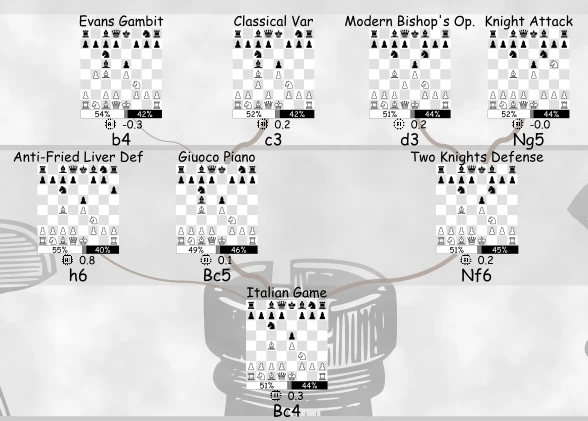
Here's the concept:
- Arrow thickness = move popularity at your ELO (thicker = more played)
- Win rate percentages = White wins / Draw / Black wins from real games
- Stockfish evaluation = objective engine assessment
- Variation names = connect positions to theory you've heard about
When you see that 4.c3 and 4.d3 lead to fundamentally different pawn structures, you understand WHY you're choosing one over the other. This understanding survives time pressure and memory lapses.
The Italian Game is perfect for this approach because it branches cleanly into distinct paths based on Black's response to 3.Bc4.
The Italian Game: Three Main Branches
After 1.e4 e5 2.Nf3 Nc6 3.Bc4, White's bishop targets Black's f7 pawn—the weakest square in Black's position since only the king defends it. Black must now choose their path.
Branch 1: The Giuoco Piano (3...Bc5)
The classical approach. Black mirrors White's development, creating symmetrical tension. This leads to strategic middlegames where understanding plans matters more than memorizing long tactical sequences.
Typical continuation: 4.c3 Nf6 5.d4 exd4 6.cxd4 Bb4+ 7.Bd2
White builds a powerful d4-e4 pawn center. Black must challenge this center with moves like ...d5 to prevent White from consolidating a space advantage.
Branch 2: The Two Knights Defense (3...Nf6)
Black challenges White's center immediately. After 4.Ng5, the game can explode into sharp tactical play—including the famous Fried Liver Attack. This line requires precise calculation from both sides.
Critical position after 4.Ng5: White threatens Nxf7, and Black faces multiple threats simultaneously. Finding the correct defensive sequence (usually 4...d5 5.exd5 Na5) requires exact play.
Branch 3: Sidelines (3...d6, 3...Be7, etc.)
These moves appear occasionally but generally score poorly for Black. Understanding why they fail helps you punish opponents who deviate from main lines.
Win Rate Analysis by ELO Level
Here's where data becomes powerful. The same move performs differently at different rating levels. A move that crushes 1000-rated players might be neutralized by 2000-rated opponents who know the theory.
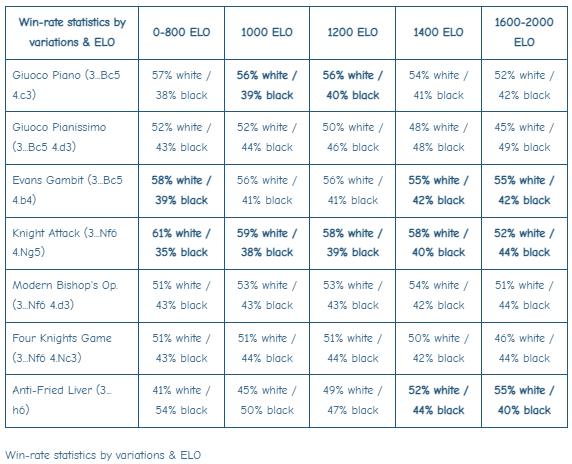
Key insight: Aggressive lines like Knight Attack (4.Ng5) perform exceptionally well at lower ratings (59-61% at sub-1200) but normalize as opponents improve. The Evans Gambit maintains strong results even at higher levels.
Choosing your variation based on your actual rating level—not what grandmasters play—gives you a concrete competitive advantage.
The Giuoco Piano: Strategic Positions
The Giuoco Piano ("Quiet Game" in Italian) contains plenty of strategic venom despite its calm name.
After 3...Bc5 4.c3 Nf6 5.d4 exd4 6.cxd4 Bb4+ 7.Bd2, we reach a critical position:
What the position tells us:
- White has a powerful d4-e4 pawn center
- Black's bishop on b4 is active but potentially unstable
- Black must decide: exchange on d2 or retreat?
- The center tension creates attacking potential for White
Strategic themes for White:
- Maintain the pawn duo d4-e4
- Develop pieces to active squares (0-0, Re1, Nc3)
- Use the space advantage for kingside attack
Strategic themes for Black:
- Strike the center with ...d5 before White consolidates
- Complete development and castle quickly
- Don't let White dominate the center unchallenged
Visual learners grasp these relationships instantly, while text descriptions require mental reconstruction.
The Two Knights Defense: Tactical Fireworks
After 3...Nf6 4.Ng5, we enter sharp tactical territory. This position requires both sides to calculate precisely.
The safer Line - Polerio Defense: 4...d5 5.exd5 Na5
Black counterattacks White's bishop while accepting a temporarily awkward knight on a5. This sequence appears complex in notation but becomes logical when you understand the pattern:
- White threatens f7 with Ng5
- Black must challenge the center immediately with d5
- After exd5, Black's knight on c6 can't recapture (it needs to defend)
- Na5 attacks the bishop AND threatens to regain the d5 pawn later
The Fried Liver: 5...Nxd5?!
If Black plays 5...Nxd5 instead, White unleashes 6.Nxf7! (the Fried Liver Attack). The king must capture, and White continues with 7.Qf3+, forcing Black's king into the open.
At lower ELO levels, this scores over 60% for White. The visual reason is clear: Black's king becomes exposed, and coordinating defense while the king wanders is extremely difficult.
Why 4.Ng5 Crushes at Lower Levels
The visual answer: Black faces multiple threats simultaneously, and finding the correct defensive sequence requires exact calculation. Players who recognize the pattern from previous study handle these positions better than those encountering them fresh.
Practical Takeaways
For players under 1400 ELO:
- Consider aggressive lines (4.Ng5 or Evans Gambit) for maximum practical chances
- Focus on understanding the tactical threats rather than memorizing 20-move variations
- Study the critical positions as patterns, not sequences
For players 1400-2000 ELO:
- The Giuoco Piano offers rich strategic positions with long-term winning chances
- Win rate advantages narrow, so understanding plans becomes more important than surprise value
- Know both 4.c3 and 4.Ng5 to keep opponents guessing
For all levels:
- Visual pattern recognition develops faster than notation memorization
- Choose variations based on YOUR rating level, not GM games
- Understanding WHY a move works beats memorizing WHAT the move is
Conclusion
The Italian Game's strength lies in its clear structure: White's bishop on c4 creates immediate tension, and Black's response determines the character of the entire game. Whether you prefer the strategic complexity of the Giuoco Piano or the tactical fireworks of the Two Knights Defense, understanding these positions visually accelerates your learning.
The data doesn't lie: at club level, aggressive lines outperform passive alternatives. But as you climb the rating ladder, strategic understanding becomes increasingly important.
If you're interested in exploring these variations further with a visual decision tree format—including ELO-specific statistics and all major branches—you can find my complete Italian Game analysis at mychessposters.com.
What's your experience with the Italian Game? Do you prefer the strategic Giuoco Piano or the tactical Two Knights? Share your favorite line in the comments!
You may also like
 RuyLopez1000
Why Are People Good At Chess?
The Rise and Fall of Chunks thibault
How I started building Lichess
I get this question sometimes. How did you decide to make a chess server? The truth is, I didn't. ChessMonitor_Stats
Where do Grandmasters play Chess? - Lichess vs. Chess.com
This is the first large-scale analysis of Grandmaster activity across Chess.com and Lichess from 200… FrancisLudwigII
The Daily Gambit #1: The Jerome (Sorry Stockfish!)
Hey everyone! I’m Lorenzo Abing (francisludwigii), your online super-prodigy, and I’ve decided to co… MyChessPosters
The Best White Opening at YOUR ELO: A 71-Million Game Analysis
What if the opening that crushes at 800 ELO becomes a liability at 1600? TheCommandalorian