
French Defense for Non-french chess players

 French Defense: A Complete Guide for Chess Players
Introduction
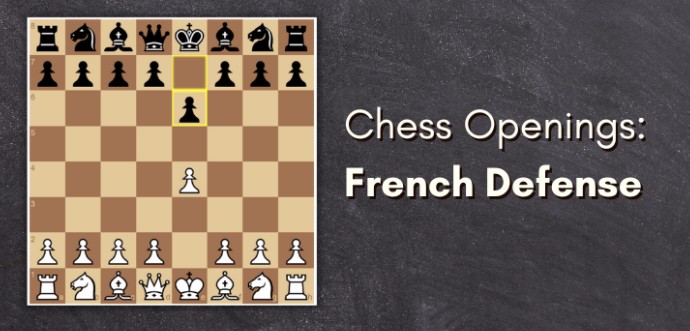
The French Defense is one of the most respected and strategic openings for Black against 1.e4. It begins with the moves 1.e4 e6 and aims to challenge White's center with ...d5. Unlike open tactical openings, the French often leads to rich positional battles, strong pawn structures, and long-term strategic plans. It has been played by world champions and remains a favorite weapon at all levels of chess.
What Is the French Defense?
The French Defense starts with:
- e4 e6
- d4 d5
Black immediately attacks White's central pawn on e4 and prepares a solid but flexible position.
Main Ideas for Black
- Challenge White's center with ...d5.
- Develop pieces efficiently behind a strong pawn chain.
- Counterattack on the queenside.
- Use the light-squared bishop creatively despite its initial restriction.
Main Variations
1. Advance Variation
1.e4 e6 2.d4 d5 3.e5
White gains space, while Black attacks the pawn chain with ...c5 and ...f6.
2. Exchange Variation
1.e4 e6 2.d4 d5 3.exd5 exd5
A symmetrical structure leading to strategic play.
3. Tarrasch Variation
1.e4 e6 2.d4 d5 3.Nd2
White avoids pinning ideas and keeps flexibility.
4. Winawer Variation
1.e4 e6 2.d4 d5 3.Nc3 Bb4
One of the sharpest French Defense systems, creating immediate pressure on White's center.
Typical Middlegame Plans
For Black
- Attack the d4 pawn.
- Break with ...c5 and ...f6.
- Expand on the queenside.
- Use the c-file for active rook play.
For White
- Maintain space advantage.
- Launch kingside attacks.
- Exploit Black's restricted light-squared bishop.
- Control central squares.
Famous French Defense Games
Mikhail Botvinnik vs Paul Keres (1948)
1. e4 e6
2. d4 d5
3. Nc3 Bb4
4. e5 c5
5. a3 Bxc3+
6. bxc3 Ne7
7. Qg4 Qc7
8. Qxg7 Rg8
9. Qxh7 cxd4
10. Ne2 Nbc6
11. f4 Bd7
12. Qd3 dxc3
13. h4 d4
14. h5 Nf5
15. h6 O-O-O
16. h7 Rh8
17. g4 Nfe7
18. Rb1 Be8
19. Bg2 Ng6
20. Be4 Nce7
Why You Should Play the French Defense
The French Defense is ideal for players who enjoy strategic battles, strong pawn structures, and counterattacking opportunities. It is reliable, theoretically sound, and effective from club level to grandmaster play.
Conclusion
The French Defense remains one of chess's most resilient openings. Whether you prefer quiet positional maneuvering or sharp tactical fights, the French offers a rich variety of plans and structures. Learning its key ideas can significantly improve your understanding of chess strategy and middlegame play.
This is my first blog,if this gets enough views I can make a part II about it :)