
How I accidentally won 2nd place in a chess tournament
I play chess for fun, not to win prizes - until I did
You know those chess analysis articles by elite players who are able to analyse their games on a level beyond the rest of us? This isn't one of them. This tournament report is about how I stumbled to the top by accident.
To be honest, I don't really study chess. I analyse every game I play on Lichess, but that's about it. I tried hiring a chess coach for a month but he gave me so much homework that it sucked all the fun out of chess and made it into a chore. I don't have dreams of getting a title so if I'm not enjoying myself, then there's no point playing.
My chess goal is modest, I just want to be a strong club player. I compete in tournaments and obviously try my hardest to win, but I know that I am competiting in the lowest section of a tournament. I'm happy to be a big fish in a small pond.
But then came this tournament.
John Bolger Cup 2023
The John Bolger Cup was held between the 17th and 19th of February in a school on the outskirts of Dublin. There were 160 participants divided into 4 sections, with 66 in the Challenger section for players rated under 1200. I had a rating of 930 which meant I was the 14th strongest player. All ratings given here are based on the Irish Chess Union's rating system which is pretty similar to FIDE.
I figured this was strong enough to get a score of 4 out of 6 or thereabouts, but I never considered myself a contender for the top. One of the toughest challenges of the tournament was the hour and a half bus commute I had to take to get there, as I unfortunately live on the opposite side of Dublin.
But once I got over that hurdle, I was ready for my first game. But then disaster struck.
Round 1 - An Easy Victory?
I was paired against a player 300 points lower rated than me, so I was expecting an easy win. We entered what I'm going to call the Fried Liver Declined for want of a better name. I was up a pawn and was putting pressure on my opponents' isolated c-pawn. But then I got impatient and over-confident, and started looking for a knockout blow. What if I used my Queen and Bishop to blow blast my opponents' kingside? The King would be exposed and I wouldn't even lose material - what could possibly go wrong?
As I was putting my plan together, my opponent made the unusual move of 18. Re5. I've hardly ever seen the Rook brought into the centre of the board when none of the pieces had been traded off and the board was still so crowded. The computer says I'm winning if I take the direct approach of punishing my opponent and attacking the Rook. Instead I got too clever for my own good.
I stuck with my plan even when I should have adapted to new circumstances (a common mistake) and took on h6 with the Bishop. I knew Black could respond with c5, but figured I could just move my Queen to g3 and use the threat of checkmate to buy time to move my pieces to safety. But then I realised I had made a terrible blunder, Black could move the Rook to e1, winning my Queen with a discovered attack. I had to retreat my Queen, losing my knight.
To make matters worse, my opponent then had the threat of mate against me which meant the loss of another piece. Had Black taken my Bishop on move 23, it would have been all lost. But then I had my first stroke of luck, as Black didn't take the piece and the eval went from an overwhelming -9.7 to a merely losing -4.2. After the game, my opponent said she effectively saw ghosts and got worried by a threat I didn't actually have.
But I kept fighting on and Black's lead started to slip away until the position was effectively drawn. Due to the 300-point rating gap, I was still playing for a win and kept telling myself I could turn it around in the endgame. But then on move 40, I realised my opponent had me cornered. She had me locked in a repetition and there was no way out without getting mated. When the game ended in a draw, my opponent was relieved and I was frustrated - until someone who had been watching the game pointed out that Black could have taken my Rook on e2 and then played Knight to d4 to fork my King and Queen.
Thus ended a game with a record number of blunders (8 for me, 9 for my opponent) and the only over-the-board game I've ever played where both players had an average centipawn loss of over 100. I didn't know whether to thankful I got a draw from a completely lost position or frustrated that I had played so poorly. Or both.
Round 2 - Attack Before They Castle
The next day, I was determined to make up for my blunders and play better. My opponent opened with a Réti that transposed into a Semi-Slav. However, my opponent didn't castle and I decided to take advantage of this. I treated my b7 pawn as bait to lure the White Queen away, so when it was taken on move 18, I launched my attack. At first I hesitated because my Bishop was undefended, but I calculated I would win two pawns and a strong attack on the King in exchange, so feeling nervous, I took the risk.
On the one hand, sacrificing the Bishop wasn't a blunder that cost me the game, it was actually a winning move. But unfortunately, I didn't take full advantage and we entered an even endgame. It was a delicate endgame with a lot of subtle pawn moves, but I had the key advantage of an active Rook, while his was stuck in the corner blocking my passed pawn. When he pulled it away to attack my King (after the game he said he had dreams of mate with the Rook on h8) I seized the advantage by pushing my a-pawn.
My opponent made a fatal mistake by trading Rooks on move 47, leaving me with two passed pawns heading straight for the finish line. His Bishop could only block one at a time, so I could sacrifice one to allow the other to become a Queen. My opponent resigned and I had my first win.
Round 3 - A Bishop Isn't Always Worth More Than A Pawn
My next game got off to a flying start when I played the Alapin in response to the Sicilian Defence. I pushed my pawns early and really liked the idea behind 6. d6 (even if the computer calls it a mistake). Not only did it prevent my opponent from developing their Bishop, but it also made it difficult to defend the Knight, which I planned to pin to the King. Sure enough, I won the Knight for two pawns and traded off the Queens before move 10 (although I probably should have taken the Queen to double Black's pawns).
I was confident that victory was all but won, so I could simply trade off all the pieces to prevent my opponent from getting counterplay. But somehow, my opponent pulled themselves back into the game. On move 27 I lost a pawn, but regained it on move 31, so I still felt confident. Without realising it at the time, on move 34, my advantage had slipped away and the game was even.
It was around move 40 that I got worried, when I realised I couldn't defend my f and g pawns and Rook on my 2nd rank was causing a lot of trouble. The computer says Black was briefly winning here, but I thought I still had an advantage. Around move 55, my opponent offered a draw but I refused because surely my Bishop is much more valuable than a pawn, right?
I kept playing out of stubbornness and the belief that somehow a winning tactic would appear to me, but it never did and reluctantly I finally accepted a draw. I felt that I had squandered a victory, although the computer says my lead was never as strong as it felt to me. After 3 games, I had drawn when I should have lost and drawn when I should have won. Did they cancel each other out or just suggest I wasn't playing as well as I should?
Round 4 - Slowly Build A Lead
I needed a confidence boost and a strong performance to settle my doubts, which is what I got in the next game. There wasn't any decisive moment, I just gradually built a lead that grew stronger throughout the game. If any move felt important at the time, it was winning a pawn on move 13. If I could win a pawn relatively easily without any elaborate tactics, then I felt confident for the rest of the game.
I thought I forked my opponent on move 24 and while I didn't win a piece, I ended up 4 pawns ahead which is always a good place to be. I planned to take advantage of the open h-file and double my rooks. Ironically, his attack on my Queen only pushed me into strengthening my attack and we both gradually realised the attack couldn't be stopped. He sacrificed a full Rook and even his Queen, but mate couldn't be stopped. I like the power of a simple and patient move like 34. e3, the kind of move I probably wouldn't have the patience for in a blitz or rapid game.
Round 5 - Game Of Pins
In game 5, I played my version of the Ponziani, where I first play my Bishop to c4, wait for them to play Bishop to c5 and then play c3. I got control of the centre and Black's Knight was on an awkward square. Then things got even better when my opponent played h6, inadvertently trapping their Knight on move 8.
Just like in game 3, I had won a piece in the first 10 moves, however, this time I was determined not to let my advantage slip away again. I thought I suceeded in forking my opponent on move 14, but they managed to escape. One result of the trade off was that I was now pinning their Rook to their King, which would be the key source of tension throughout the rest of the game.
If this game was defined by anything, it was the use of pins by both sides. The Rook was stuck on f7 for most of the rest of the game, but still had power to attack on the f-file. My opponent fought back well, exploiting some pins of his own, equalising and was even winning for a move (although the logic of the engine is based on moves players at my level wouldn't make). It was an incredibly tense game where every move had to consider a dozen different ideas and possible responses.
Move 25 was crucial in deciding the game. I knew I absolutely had to keep his Rook pinned to prevent him from attacking full force. Qh2+ was scary, but I realised that I could run my King to safety and he would run out of checks. When Black offered the Queen trade on move 27, I would have accepted if it wasn't for my experience in game 3, instead I wanted to keep the pressure on. This paid off when I took his Bishop on move 33, Black couldn't take back without losing their Rook. I could finally breath a sigh of relief, the tension behind the pins had been removed and I was now +5 in material.
I then traded off Rooks, which the engine calls a terrible blunder, but seemed like a great idea in the game. I probably should have taken on g7 with the Knight, but it had been a gruelling game and I just wanted to simplify. I was afraid that my opponent would make me play out the endgame (the playing hall was emptying as most other games had already ended), but eventually they resigned. It was a tough game and just goes to show how you can still fight on and have chances even when down a piece.
Round 6 - My Accidental Victory
I was feeling pleased with myself heading into the last round, glad that I had made up for my rocky start. I had played well, got some nice wins and was steadily making my way up the boards, going from board 16 to board 2. That being said, my performance was nothing spectacular, especially when you consider my victories came against players rated 100-150 points lower than me. Now the shoe was on the other foot, as my last opponent was over 100 points higher rated than me.
In response to the Queen's Gambit, I played the Slav. This is my usual response, but one thing I hate about the Slav (and the Semi-Slav in particular) is how useless the light-squared Bishop becomes when it's locked behind the pawns. However, I've had enough bad experiences in online chess to know how dangerous it is to put the Bishop in front of the pawns if White launches a strong Queenside attack. I knew this and yet still did it! There's no good explanation, I basically just hoped I could move the Bishop and White wouldn't punish me for it. Unfortunately, they did.
By move 13, I was screwed. I was down a pawn and couldn't save my Rook. The engine gives White only a slight 1.5+ lead, but in the game I felt I was completely losing. It was only the memory of my previous games that kept me going, if there was any lesson from this tournament, it was that you can still get counterplay when down a piece and a draw was still an option.
So I fought on, trying to make things as difficult as I could for White and delay the inevitable. On move 24, I made what I thought was a brilliant gambit that would sacrifice my Bishop to win a Rook. Only after I made it did I realise that it didn't work. If White took my Bishop with the pawn, I could retake with my Queen, but now my Rook is undefended. Luckily, White didn't take full advantage, instead trading their Queen for my Rook and Bishop.
Somehow, I was no longer losing. White is still +2 in material, but my Queen is far more flexible than his cumbersome Rooks that always need to be connected. I could jump around the board, threatening everything and he was forced to be merely reactive. There's not much hope I could win in the position, but I wasn't trying to win, my plan was just to harass his King into give me a draw.
Evetually on move 33, I got to h1, a position which game his King no squares to move to and no way to protect the h2-pawn. Now I could give unlimited checks until it was a draw or he sacrificed the g-pawn (which still might lead to a draw).
But then my opponent did something completely unexpected that changed the course of the tournament for me.
On move 36, White moved the King to g4, instantly losing the game. This is why I used the word "accidently" in the title, I didn't win because of any clever move on my part, in fact I wasn't even trying to win, I just got extremely lucky. I never dreamed my opponent would move the King forward, I was fully expecting them to move back. After the game, my opponent told me a draw would get them 2nd place, but a win would get them 1st, so they were still playing for a win. I could immediately tell it was an error, couldn't I now use the pawns to give check? Wasn't the King now trapped between my Queen and my pawns?
For the last 10 moves my Queen had been charging around like a bull, attacking everything, everywhere. But now, I resisted the urge to charge in immediately, instead I slowly moved my King to defend the pawns and away from any potential Rook checks. Only then did I bring the Queen, not to check, but to cut off all the squares around the King and ensure that while White had one Rook check, it didn't have two. It was over and my opponent resigned.
I Swear It Was A Serious Tournament With Adults!
As a complete surprise to me, I ended up joint 2nd with 3 other players, winning a prize of €75. I had never even considered that I could ever win a prize in a chess tournament, I would have been happy just to gain some ratings points.
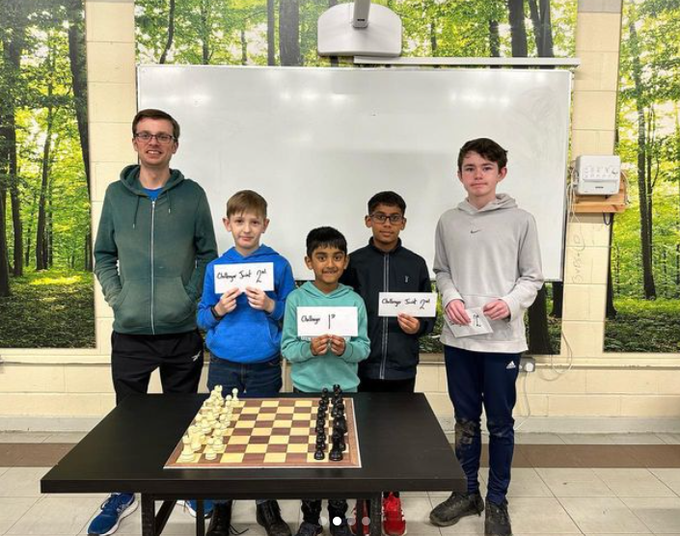
My performance had a comical result, as in the group photo of the winners I'm at least a foot taller than the others. That's because the ages of the runners up are 10, 10, 13 and 31 (guess which one I am), while the overall winner was 7. Even though the tournament was full of strong players of all ages, it looks like I entered a children's club. When I showed the photo to friends, I had to clarify (once they stopped laughing) that it was in fact a serious tournament, with lots of adults
Overall, I had a performance of 1081 and gained 36 rating points, taking me from 930 to 966. I was delighted with myself, but little did I know that I would do even better in my next tournament.


