
Inside a Soviet Chess School
USSR Chess School: Chess Machine Factory
The Soviet school of chess is something that cannot be repeated.
Why did the USSR dominate chess?
Today we will try to understand the secret of this monopoly in a game with 64 squares, a game called chess.
Specifically, today we will be talking about:
- Introduction
- Talent Selection
- Secrets of preparation
- World Championships and all the strange stories associated with them.
- Last breaths
- Conclusion
Let's enjoy this deep dive into the Soviet chess!
From the origins and Lenin's slogan: "Chess for the masses!" to the Botvinnik-Kasparov University.
Introduction
If you were a chess player in America or Europe, you were most likely an amateur, playing with your grandfather, or simply practicing in your spare time.
In the USSR, it was a religion or something like a weapon during the Cold War, where second place was tantamount to treason.
Talent Selection
With the goal of always taking prize places, the USSR needed only hand-picked wunderkinds who would then be raised to become champions.
How exactly were geniuses selected?
The USSR had something you won't find today: the Soviet Union had Pioneer Palaces.
What does this mean?
It was a gigantic network of free summer youth clubs.
And it was from here that the Soviet Chess School selected its champions.
Here's how it worked:
- Free chess tournaments were often held at Pioneer camps.
- If you stood out among others for your memory, calmness during the game, combination vision, etc., then you were chosen by leading chess teachers.
- Then you were taken away from your family to a special chess academy where they raised winners.
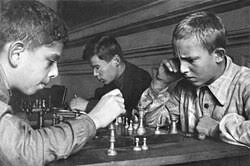 A chess tournament from which children were selected for the academy.
Secrets Of Preparation
There were different chess universities, but the most popular ones were those under M.M. Botvinnik, T. Petrosian and V. Zak.
Children's Preparation
If you were chosen for such an academy which were more like military camps mixed with academic knowledge, you packed your bags and left your parents for Moscow, where the academies were based.
You lived, ate, slept, and spent your days learning chess from masters.
A very important detail: so-called "romantic" chess was strictly forbidden. You had to play logical and strategic chess.
The USSR Chess School had the "Blind Assault" method, which meant they sat you facing the wall and forced you to mentally calculate the most complex positions, look for checkmates in seven moves, etc. (Whitout a board)
Master - Grandmaster Level
If you did really well, you were promoted to a higher class; that's how the Soviet school worked up to the Master level.
Once you crossed that threshold, they began training you like a machine.
They applied the Botvinnik method to you, which meant you had to self-critique and know certain openings selected specifically for you to incredible depth.
Here you can see the win percentage of each world champion trained by the USSR at a specific opening.
Using this graph, you can see which openings were frequently studied in the Soviet school, most often aggressive and initiative-seeking.
You may also notice that some players have very high win percentages in one opening but very low win rates in another. This demonstrates that the openings were strictly tailored to the players.
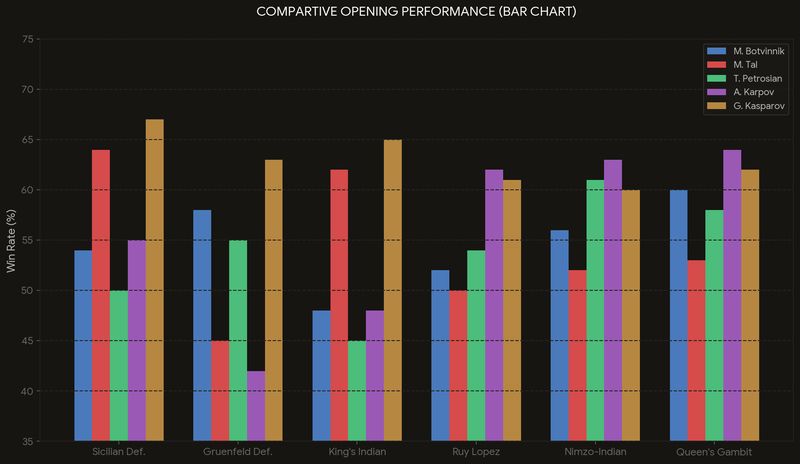
You can find an in-depth analysis of the openings played by the USSR champions in my study: If you are interested in studying the English Opening, Sicilian, and King's Indian Defense, welcome to my study!
Botvinnik himself believed the brain couldn't calculate variations after the fifth hour of a game, so he forced his students to run cross-country, chop wood, and even do gymnastics.
Doctors adjusted your diet and trained you in mentally impossible conditions—all to improve your concentration even under difficult circumstances.
The Soviet school also invented the "Collective Analysis" method. While in the West, chess players would typically hire a coach and search for ideas themselves, in the Soviet Union, dozens of people searched for the right lines.
The USSR also had a secret library of "Novelties". All of this was kept top secret, and at a tournament, after you played this novelty, your German opponent would spend 20 minutes searching for the right line, simply because they lacked the knowledge—USSR were the only ones with this line.
World Championship Level
If you reached the pinnacle of the chess world, the world championships, then preparation became absolutely unrealistic.
You trained 2 times harder!
This graph shows Soviet chess players in red and foreign players in blue.
This demonstrates the effectiveness of the Soviet school.
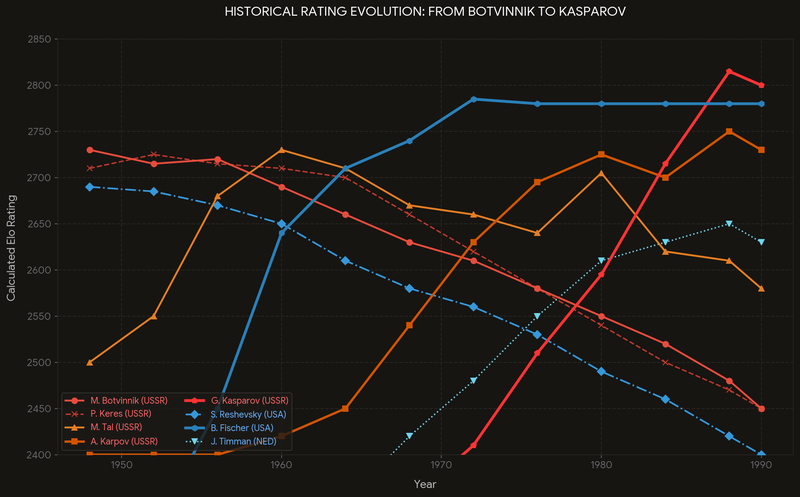
World Championships and all the strange stories associated with them.
Matches Abroad
During the Cold War, every trip beyond the Iron Curtain was strictly controlled by the state.
When traveling to the World Championship, you had a whole delegation with you: you couldn't travel alone, as Americans or Europeans did.
This delegation always included KGB officers, who monitored you at all costs and always checked your room for bugs.
Chess players abroad weren't paid their usual salaries: they were paid a per diem, which was simply tiny.
Also, if you won the World Championship, for which you could receive hundreds of thousands of dollars in cash, you gave up to 90 percent of your prize money to the Sports Committee.
Some, like V. L. Korchnoi, didn't like this and fled the country.
Korchnoi also fled because of the race—you might not be chosen even if you were a very good player, since the Kremlin always had favorites like Karpov. And even if you were stronger than Karpov, but disagreed with even the most minor thing, you wouldn't be chosen, because Karpov was more loyal than you.
With the remaining money, grandmasters could buy things abroad that weren't available in the Soviet Union.
There was also enormous psychological pressure, as second place didn't exist in the USSR: before your trip, you were summoned to the leader, who reminded you of your duty to your homeland. If you did lose to a foreign player, your salary would be reduced and all sorts of sanctions would be imposed against you.
This forced chess players to push themselves to the limit, but it also took a heavy toll on their mental health.
A clear example: Spassky lost a match to Fischer in 1972, and in his homeland he was subjected to severe disgrace and deprived of state support!
 The Soviet delegation at the Karpov - Korchnoi match, 1978
Karpov - Korchnoi, 1978
This match between the Kremlin favorite Karpov and the "traitor to the Motherland" Korchnoi, who had received political asylum in Switzerland, was perhaps the most mystical in modern chess.
The battle in this match was fought not only at the board but also in the stands.
The delegation for this world championship match officially included hypnotist Vladimir Zukhar, who sat in the front row and attempted to "radiate negative energy" by staring incessantly at Viktor Lvovich.
Korchnoi's response to this was also unexpected: he invited yogis from the local sect "Anada Marga", who "were supposed to block Zukhar's negative energy".
Also worth mentioning is the blue yogurt scandal. During the second game, Karpov was offered blueberry yogurt, and Korchnoi immediately protested:
"It's all a conspiracy theory. The Soviet theorists sitting in the hall agreed in advance that, for example, blue means attack, red means offer a draw."
After that, FIDE regulated the color of the yogurt and the time it was served.
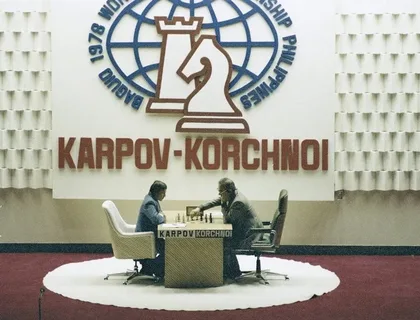 Karpov vs. Korchnoi Chess Championship Match, 1978, Baguio, Philippines
Last Breaths
The Botvinnik-Kasparov School
As Botvinnik's school was approaching its demise, Garry Kasparov, who had studied at the same chess academy, arrived. He helped with the money and introduced one very important change: computer training.
Decay
Today, the concept of the Botvinnik-Kasparov school no longer exists; this school has disintegrated into different parts of the world.
Conclusion
Today we delved into the chess system of the Soviet Union, which produced thousands of outstanding chess players, the most famous of which are
- Kasparov
- Karpov
- Spassky
- Korchnoi
- Kramnik
- Petrosian
- Tal
- Smyslov
After this, one more important question remains: Why is it impossible to restore this system now?
In the USSR, chess was perceived as a weapon against the United States during the Cold War. The Soviets wanted to distinguish themselves by their intelligence before the entire world. This was the motivation for such a fundamental project.
Interesting fact: Fischer stood alone against the entire Botvinnik school, and he won. This shows that if you have talent and a dream, you are capable of anything.
I hope you enjoyed this analysis of Soviet chess; after all, I worked hard and would be very happy if you liked this article. Thank you in advance.
Who do you consider the Soviet school's prodigy?
Option 1: Kasparov
Option 2: Karpov
I look forward to hearing from you in the comments!
Have a good day, good health, and good luck in your chess adventures.
You may also like
 FM MattyDPerrine
What “Talent” Actually Means in Chess (It’s Not What You Think)
Talent exists but it's not what's holding you back. CM HGabor
How titled players lie to you
This post is a word of warning for the average club player. As the chess world is becoming increasin… TheAndrei
Play with style: Ultimate Repertoire.
Crush your rivals with these legendary openings GM Avetik_ChessMood
10 Things to Give Up to Enjoy Chess Fully
Discover how embracing a lighter mindset can help you enjoy chess again and achieve better results. thibault
How I started building Lichess
I get this question sometimes. How did you decide to make a chess server? The truth is, I didn't. likeawizard