
What Reading About Human Intelligence Has Taught Me About Chess
In the room where I often sit to study chess, there’s a sort of "mini-library" filled with my dad’s favorite books, and recently, I’ve begun exploring them. My interest has especially gravitated toward books about the human mind and the science of intelligence. At the moment, I’m reading The Dragons of Eden by Carl Sagan, which has led me to draw intriguing connections between chess and psychology. While these insights may not directly enhance one’s chess skills, I find them fascinating and would love to share what I’ve discovered.
Here are five concepts where I’ve found interesting parallels between chess thinking and the human psyche. Enjoy!
1. The Evolutionary Layers of Chess Thinking
Sagan discusses the triune brain theory, which divides the brain into three evolutionary layers:
- The Reptilian Brain – Handles automatic responses, aggression, and territorial behavior.
- The Limbic System – Governs emotions, social behavior, and decision-making under stress.
- The Neocortex – Responsible for logical reasoning, problem-solving, and creativity.
A chess player can see this hierarchy at work during a game. Blitz chess, for example, often relies on instinctive pattern recognition (reptilian brain), while classical chess requires deep calculation and planning (neocortex). Understanding these layers can help players improve their emotional control, recognize when they are making instinctive rather than calculated moves, and optimize their thinking for different game situations.
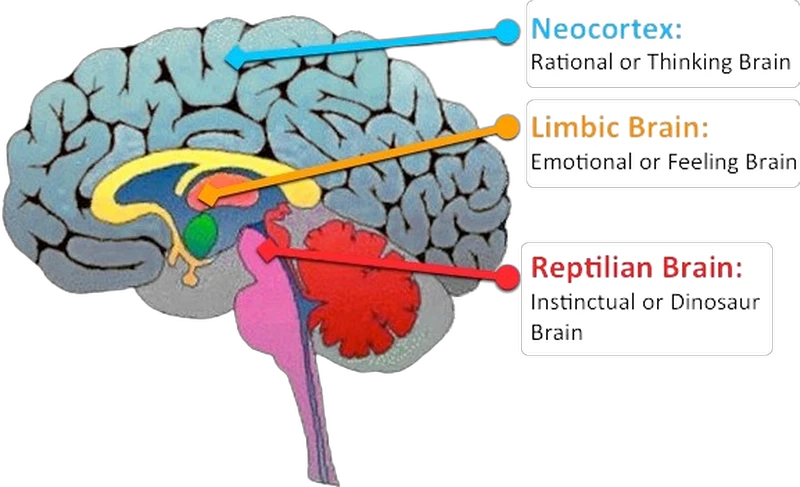
A simple illustration showing the mentioned components of the brain.
2. Pattern Recognition and Its Role in Chess
Sagan emphasizes that intelligence is largely about recognizing patterns and making predictions - something that is particularly important in the amazing game of chess. Chess players do not calculate every possible move; rather, we rely on experience and familiarity with positions to choose the best options quickly. This mirrors Sagan’s argument that intelligence evolved not to compute every possible future but to focus on the most relevant information.
By refining our pattern recognition through studying model games, tactics, and endgames, we can improve our intuitive decision-making and develop a more efficient thinking process. Similarly, AI chess engines like AlphaZero have demonstrated a pattern-based learning approach, where instead of brute-force calculation, they recognize key strategic patterns through self-play and reinforcement learning.
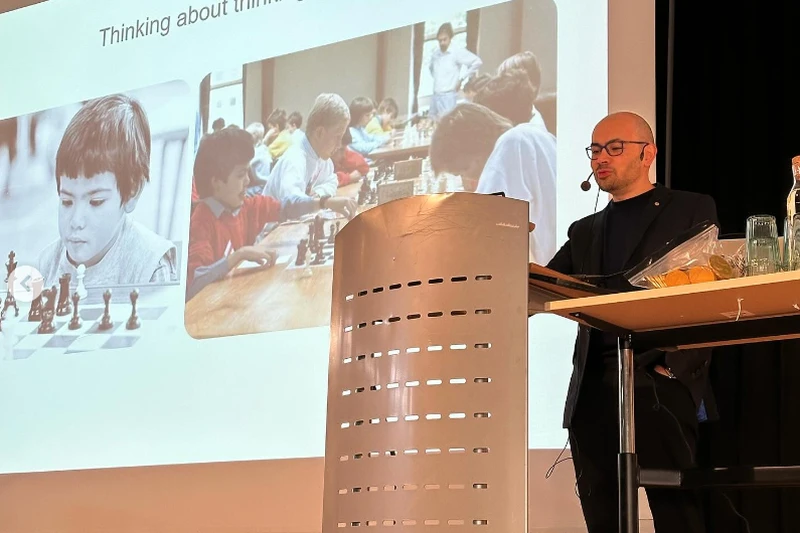
Here is AlphaZero creator Demis Hassabis holding a lecture at my highschool. Hassabis is a former chess prodigy, nobel prize winner, co-founder of Google DeepMind and much more.
3. Emotional Influence and Cognitive Biases in Chess
Sagan explores how the limbic system (The emotional part of our brain as aforementioned) influences our decisions, often causing irrational behavior. Us chess players frequently experience this when we blunder under pressure, tilt after a loss, or fail to take risks due to fear of failure (trust me, I've been there too).
Recognizing these emotional responses can help us as a player develop mental resilience. Strategies such as mindfulness and breathing exercises can mitigate the negative impact of emotions, allowing for clearer, more rational thinking during a game. I believe this may be one of the key factors behind India's rapid rise in chess. Indian culture places a strong emphasis on meditation, stoicism and inner calm - qualities that are evident in players like Gukesh, Praggnanandhaa, and Vidit Gujrathi, all of which have been seen meditating before games (or even during them!).
4. The Role of Imagination/Visualization in Chess
Sagan describes human intelligence as being defined by our ability to imagine different futures. Chess is, at its core, a game of simulated future possibilities. The stronger a player’s ability to visualize potential board positions, the better their plan. Just as human intelligence evolved to anticipate dangers and opportunities, a chess player must train their imagination to foresee and prepare for different tactical and positional outcomes.
AI engines like Stockfish and AlphaZero also predict future positions but do so through vastly different means. Stockfish relies on brute-force calculation and heuristics, while AlphaZero uses neural networks to predict and evaluate positions dynamically. This distinction parallels the differences between human and machine thinking - while humans rely on intuition and learned experience, AI models use statistical optimization to arrive at superior decisions.
5. The Psychological Battle: Understanding Opponent Thinking
This might be a bit far-fetched, but since The Dragons of Eden delves into human cognition, it also provides insight into understanding an opponent’s thought processes. A chess player who can analyze not just moves but also psychological tendencies (whether an opponent is aggressive, defensive, or prone to time trouble etc.) can gain a small advantage. By predicting an opponent’s mindset, a player can make moves that are not just objectively strong but psychologically effective.
During a camp in norway 2 years ago I asked Magnus a question surrounding this topic. The question was Do you adapt your playstyle depending on the opponent? and his answer was:
"I think the most important thing I realized over the years is that a lot of people fear me. Once you realize that your opponent is not mentally prepared to play for a win, then you can take a lot more chances."
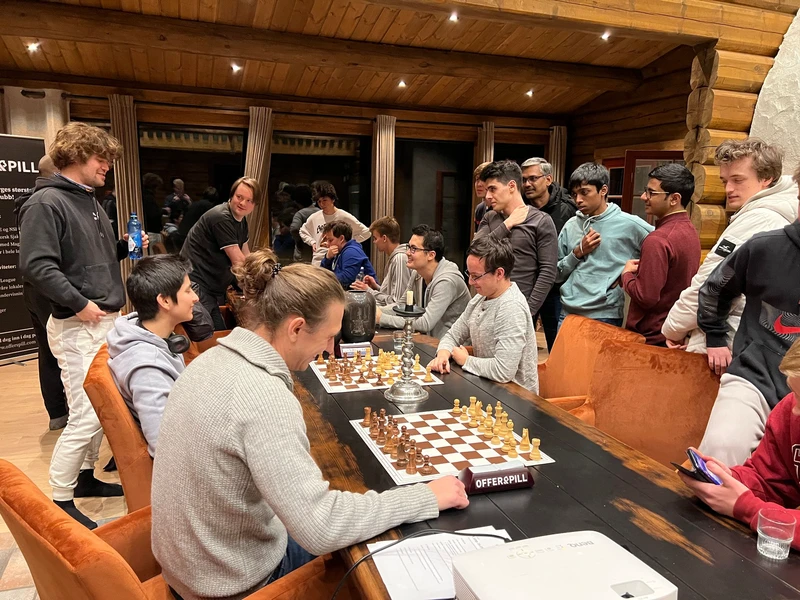
A picture taken from the camp in norway with Magnus present.
Conclusion
Reading about human intelligence has deepened my appreciation for chess, not just as a game of strategy but as a reflection of how our minds work. From the instinctive reactions of the reptilian brain to the abstract reasoning of the neocortex, chess mirrors the complexities of human thought and decision-making. Pattern recognition, emotional control, imagination, and psychological insight all play vital roles, reinforcing the idea that intelligence, whether human or artificial, is about efficiently navigating uncertainty.
If you’ve found this post interesting, feel free to leave a like and don’t forget to follow me here on lichess for more blogs about chess!
You may also like
 FM Zig_Zag_Zug_Zwang
Learn From One Of The Best Coaches In The World
In December of 2022 I attended a weekend long chess camp in Uppsala, Sweden. The man who was coachin… FM Zig_Zag_Zug_Zwang
Chess is a Mirror of Real Life
As chess players, we’ve all been there. The tournament hall is dead quiet, par for the rhythmic thum… IM theScot
Home Cooking: the Good, the Bad, and the Ugly
A post about the effect of opening preparation in modern chess GM Avetik_ChessMood
10 Things to Give Up to Enjoy Chess Fully
Discover how embracing a lighter mindset can help you enjoy chess again and achieve better results. CM HGabor
How titled players lie to you
This post is a word of warning for the average club player. As the chess world is becoming increasin… FM Zig_Zag_Zug_Zwang