
Grenke 2025 - My experience as an FM
Get some insight on how chess opens are and let's learn some stuff from my games!
Hi! My name is José Bárria, I am an FM from Portugal, and from 17th to 21st of April 2025 I played in the Grenke Chess Classic, and I wanted to share my experience with you :)
Recent chess career context
I hadn't played an open tournament for a while - not so much because my last open was a disaster, but more due to a tight schedule at university. I'm currently taking a Master's Degree in Software Engineering (AI, more specifically), in Lisbon, and I find more time to play tournaments in holiday breaks such as this one (Easter break).
Speaking of my last open tournament, this was the European Individual Chess Championship in November of 2024, in Petrovac, Montenegro.
As you can see, it went really badly.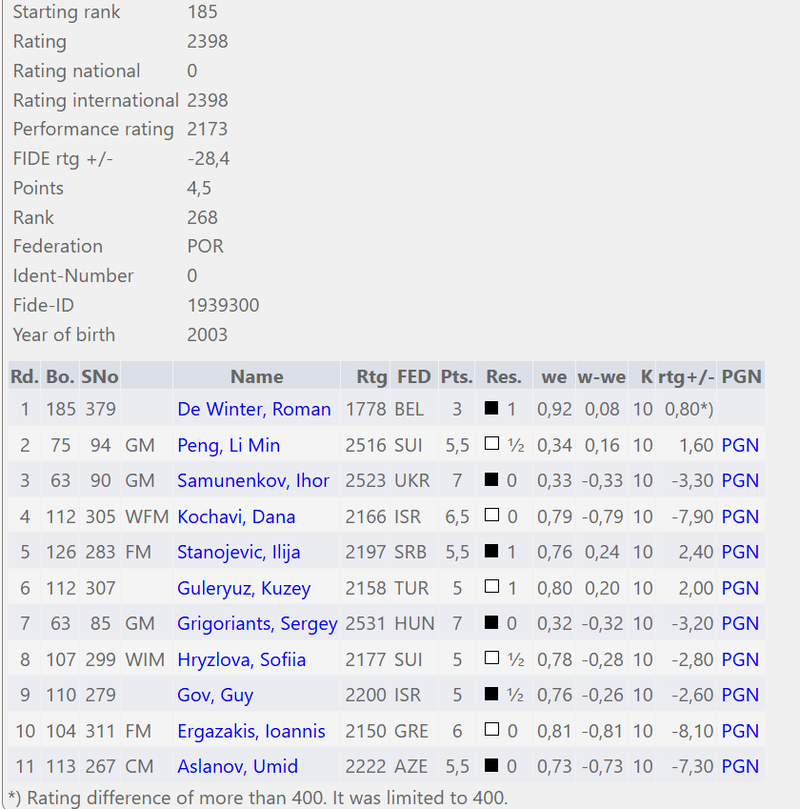
Actually, my last year was pretty much always downhill chess-wise. I had a couple of good tournaments, but I couldn't get a norm out of any of them, so the total balance of the year was terrible (blue line is classical chess, which is basically all that matters).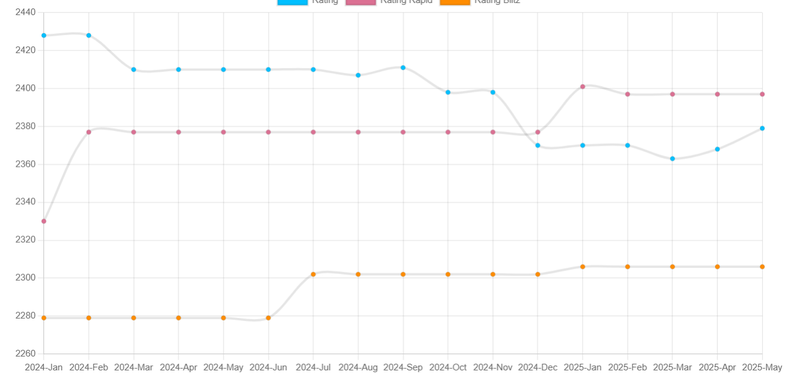
These periods are very tough mentally, but it's part of being a competitor. After the tournament I am about to show you, I believe I have found my feet again and hopefully we'll get back on the horse! :)
About the tournament
The tournament was played in Karlshue, Germany. This is not one of the main cities of the country so the environment was very light and uncrowded. With that said, the tournament had over 3000 participants, which is a colossal amount of people, for any chess tournament around the world. We went in a group - myself, FM Bruno Martins, Lourenço Silva and Miguel Rodrigues, and stayed at the Q-Quadro Hotel, which was 10 walking minutes away from the playing hall. Bruno and I are actually old friends and chess rivals, and we're both in very similar situations, being around 2370 and needing one more norm to get the IM title.
It's always nice to play an open tournament with friends as there are many games to analyze afterwards, and stories to tell and so on... :)
Disclaimers about the analysis
The analysis are very personal. I try to use as least engine as possible, and it is a hard challenge to actually learn from the engine, instead of just seeing the right moves and being like "Oh, I'm so stupid, of course I had that." It's usually easy to understand the right moves, but it's hard to understand why you didn't find them yourself. That's where the learning lies.
Most "ideas" from the sub-lines are mine, and I explicitly say when they are from the engine. Of course, I'm not always going to mention when the computer corrected me on trivial things, such as hanging pieces in the analysis, and so on... The blunder-proof correction part was obviously done with the engine, but there might still be some errors that I missed.
Lastly, I originally annotated the games in portuguese and then translated it to english. It was actually quite time-consuming, so you might find some english mistakes here or there.
Now, on to the games!
The games
I will leave the link to the study I created here, and in this post I will only mention a few key positions from each game.
Game 1
The opening of the first game was a KID I played with white (which is always nice). More specifically, the Gligoric System, with Nf3 Be2 Be3.
My opponent played in a way that I don't think is optimal, and at this point he has a suspicious looking position I could have exploited.
Eventually, I got a dominating positional advantage in the endgame, and the game concluded in a position with even material, which is always nice :)
Game 2
The second game was the least interesting out of the 9 I played. It was just one of those annoying games where the opponent plays for a draw the whole game, and has enough of a level to where he gets the draw a lot of times.
Here was the only moment where I consider I made a bad move, at least, in practical terms.
11...exd4 would have kept more pieces on the board and I might have had more chances to outplay him. If your opponent really wants to draw and plays well enough for it, sometimes, there is not much you can do.
We traded more and more pieces and made a draw a couple moves after this position.
Game 3
In this game my preparation was extremely poor. I was trying to follow an old Kramnik game, but I couldn't remember it at all. I ended up playing a highly unorthodox 10.Ne5, which somehow is still interesting.
Anyways, I got a horrible position but fought well at the board and created chances.
My style isn't exactly so positional, but I'm easily disgusted by unaesthetic positions, such as my pawn structure here. He luckily blundered heavily with 31...f6, missing my next move, and I managed to navigate my way well through the complications that arose.
Game 4
In this game and a few others, I got paired with a 2100 player that was gaining a bunch of elo in the tournament. This is usually one of the worst pairings to get because you're playing low-rated people that are beating stronger guys like yourself. It also doesn't help that he immediately starts the game with an Alapin, which is known to be very drawish (like the London System). Anyways, I am very happy to have defeated almost every lower-rated opponent I had in this tournament :)
The opening was not so critical and we reached a normal looking position around here.
Black is fine, but it's hard to create play. This game did not have any super critical moments, but here is where the tide started to shift.
Had he played 21.c4, it would have slowed down my counterplay considerably. Once I started to roll with the pawns on the queenside, he got into trouble, and his plan of bringing the king to the center also was quite poor.
Game 5
Finally a good opponent for me, and with the white pieces. My opponent played a Slav with 5...a6, Bb4 and then Bd6 (this has some name that I can't remember). This is not one of the main lines in the Slav, but it exists. Once again, my preparation was not great and I couldn't remember the theory in this line.
After thinking for a long time at the board, I managed to actually play some theory and could have done myself a favour on move 15 by not playing exd4.
Since the computer line after 17.Qf3 is nearly impossible to see (for me, at least), I should have played another move like 15.Ne4 and the game was just equal, with some small chances of an advantage for me. Instead, I had to find 17.f4! and then still suffer for quite some time in order to escape.
Eventually, I found this nice idea to trap his knight, even though he had almost the whole board to move to, and secured the draw.
Not a great game, with the white pieces as well.
Game 6
On round 6 I got paired with a young 2600 player with the black pieces. Always a tough pairing, but it would have helped if he had played 1.e4, since he had over 1000 games in the database with that and I had prepared something very deeply prior to the tournament. But ok, 1.d4 it is. My main weapon is the KID with black, but I must admit I did not have the courage to play it against him, so I went for something more solid.
I knew the line until here, which was, again, not great preparation by me, but I actually enjoyed this game quite a lot. The exchange sacrifice came naturally to me, and the computer doesn't hate it. It seems that his move 18.Rac1 was actually as brilliant as I thought it was during the game, which I am happy to know.
This is why I don't like playing people over 2600. They find stuff like this. The position now became very difficult to handle, but my defense and time management were both terrible and I deserved to lose.
Game 7
The beginning of this game was pretty funny because I arrive at the board and his jacket is on the chair of the white player, and on the board is 1.c4. I went back to check the pairings and, indeed, I was playing white, not black. So I went to call the arbiter, he comes to the table, explains to my opponent that he is playing black, and that's the story of how I won back the 15 minutes I was down for being late.
Another KID, another Gligoric (I played many KID's this tournament!), and after a very suspicious opening sequence, I manged to get in 13.h4!, and paralise his kingside.
After this, I got a positionally winning advantage on move 19, and honestly, my opponent didn't put up any resistence at all, apart from playing super fast and making me burn all my time (ok, I did that myself).
Eventually I broke through with 32.f6 and some tactics guided me along the way to victory.
Game 8
Two rounds to go and I get another 2100 that is gaining like 50 elo points, instead of playing a stronger opponent, as I expected. Great.
He played some shady, murky opening, but propmptly revealed his intentions to play for a draw the whole game, and make my life miserable. Anyways, we quickly got down to this position.
I wasn't so bummed about this. Not-so-strong players tend to misplay these positions all the time and assume it's just a draw because there's no queens. Definitely not true, and by move 25 I was starting to build up a nice position, had I not played this move 25...a6?, which seems innocuous, but allowed him to improve his position with some tactical assistence. After some mistakes by both sides, I started building up the pressure around this position.
His pieces are quite passive and the Pe4 fell in just a couple of moves, and I am quite happy about my conversion afterwards. Probably the two most important skills you can have as a chess player are winning won positions and saving lost positions. I managed to do one of these things in this game.
Game 9
In the infamous last round, I supposedly only needed a draw to clinch the IM title, since I have 2 norms and have crossed 2400 in the past. I asked him if he wanted to draw, he said let's play, and then played this super funky King's Indian Defence (another one).
The KID is already not so good, so this crap has to be even worse, but my mind was very clouded with the norm stuff (typical for these situations) and I didn't play to my best this game. I was scared to death of playing 14.f3, but what I really shouldn't have played is Bh6 in conjunction with f3.
This decision to take on b5 with the pawn was interesting (to my eyes) and the game took unorthodox paths.
I also am quite happy about the fight I put up in this game, and eventually I started to play for a win on move 25.
Black doesn't have anything to do and I will try to improve my position gradually, starting by kicking away the Nc5.
32.g3 was much more clever than what I did, and I stretched myself very thin with this 36.g4 idea.
After many heart attacks I managed to get the draw.
Immediately after getting the draw we celebreated, and celebrated for many hours, until, only in the award cerimony, I get informed by a friend of mine that is an arbiter - Paulo Rocha -, that I was not elegible to make the norm. Funny enough, I was already not elegible in the last two rounds.
What happens is that there are a lot of criteria for norm elegibility, but basically, the only two that people care about is your performance (has to be above 2450, for IM norm), and whether you played 3 IM's (or GM's). That's really the hard part. But another criterion is that you need to play at least 5 titled players, of any title whatsoever. I played an IM on the last round, a 2200-IM on game 7, two GM'S, and, as I painfully came to know, none of the 2100's I played had a title (which is quite rare). This requirement, and others like needing to play 3 players from different countries, and other rules, are not even thought of, because they are usually met in open tournaments. For example, my friend Bruno had a slightly lower average opponent rating and still had 7 titled opponents (I only needed 5!).
Tournament Conclusion
Even though I have "hit the post" many times when it comes to making my final IM norm, I wasn't too phased by this disapointment. I am overjoyed with the tournament I had - from the actual games to the overall experience - and am mainly glad to have played my normal chess again, with tranquility and enjoyment. It's interesting to note that when I am feeling this way on the board, the tournaments almost always go my way. I finished tied for 43rd and gained 1.1k's (11 elo points).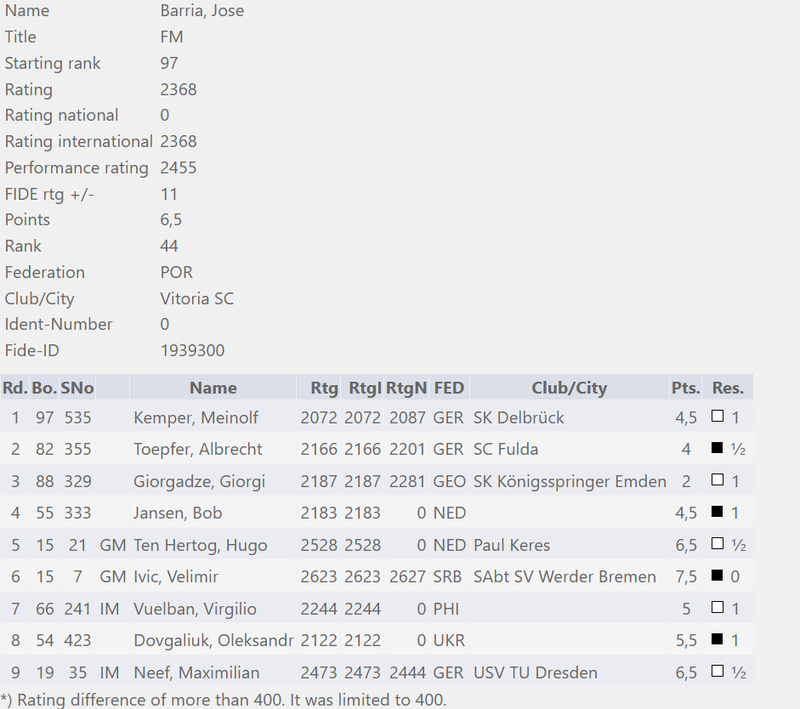
Final thoughts and remarks
The Grenke was super fun and it is definitely a tournament I'm looking to come back to. However, it did have its problems. The main thing I didn't like was the anti-cheating control. Over 3000 people playing and there was literally zero measures. People could actually bring their phones with them to the board - that's just mental. Also, I was explicitly told by one of the tournament arbiters that wearing a watch (even if non-digital) was forbidden, yet there were people still wearing them. In our modern days, it's pretty sad to think that out of that sea of people, some probably cheated... Trusting people's goodwill is, unfortunately, not enough.
Moving on, we stayed an extra day at Frankfurt in the end, at a friend's house, just to explore the country a bit, since we didn't get to see much during the tournament (all days had double rounds). We really liked to see Germany a bit more, and we ended up seeing Karlshue, Frankfurt, and a bit of Sttutgart, because we took the flight there. The whole trip was about 800 euros, that is with flights, accomodations, food, all included.
Chess-wise, I think my main problems were in the openings, and that's where I need to work more.
Hope you enjoyed my first blog post! It is long and took my some time to put together, but I hope it was worth it :)
You may also like
 ChessMonitor_Stats
Where do Grandmasters play Chess? - Lichess vs. Chess.com
This is the first large-scale analysis of Grandmaster activity across Chess.com and Lichess from 200… IM HelloItsDmitri
Confirmation Bias - What is it, and how does it apply to chess?
Confirmation Bias is one of the more than a hundred cognitive biases that human brains are victims o… NM HarpSeal
Why Leela Plays Bad Moves (That Work)
Why does Leela play like a weirdo in odds games when she's down a lot of material? IM HelloItsDmitri
Why are tactics critical for chess improvement at all levels?
Tatics are what win games at the beginnings of our chess journey. However, the stronger we get, the … FM Zorbos
Why Are Some Openings So Weird?
In some openings, we can just aim to get our pieces out, castle early, and play a calm, strategical … IM HelloItsDmitri