
The Weird Side of Chess
Let’s take a closer look at the stereotypes of the chess world and some ridiculous facts about chess players.
Before we start, I would like to share a few important things.
The information that is being provided and which you are about to read are 95% by myself (Some I referred to Wiki and other websites). I hand-typed each sentence on my own. However, I did take the assistance of ChatGPT to 'reword' some paragraphs just to make it consise and narrative. I did not rely on it for the information. So, kindly do not mistaken this as an AI blog.
It took a lot of time and effort for me to create this. I am not expecting any appreciation, but neither gonna encourage/tolerate any criticism.
Introverts
By its very nature, chess is an isolating career. Even though players may train with coaches and friends, ultimately it is the individual effort and focus that determine success. To improve rapidly, one must spend long hours training alone.
As a result, many players feel little need to step outside their familiar environments. Even at professional academies, the faces they see and interact with each day rarely change. Their routine often revolves around a simple cycle: going to the training center, practicing, and returning home. Since their world already provides everything they require. Hence the urge to socialize or explore beyond it diminishes.
Over time, this lifestyle can also contribute to a natural sense of shyness or social withdrawal.
Superstitions
Believe it or not, almost every chess player harbors a superstition each in their own peculiar way.
Take for example, GM Hikaru Nakamura during the 2024 Candidates Tournament. He famously wore the same colorful, patterned shirt for several consecutive rounds, convinced it brought him good luck.
Some superstitions are even more amusing. For instance, certain players avoid repeating an opening sequence that once cost them an important game — not for strategic reasons, but simply out of superstition. Some others try to recreate every detail of a lucky day: eating the same breakfast, following the same routine, or even wearing the same clothes they wore when they defeated a higher-rated opponent.
And it doesn’t stop there. Some players even refuse to change their socks during a winning streak, believing it might break their luck. Many (including myself) would be using a specific “lucky” pen for recording moves, while others go as far as positioning their knights in a particular direction before the game begins — all in the name of good fortune.
Some chess players even choose to arrive late to their games, believing that doing so might bring them good luck which is a purely superstitious habit.
Nervousness
For some reason, almost all chess players feel a wave of nervousness before a game even when they’ve prepared thoroughly.
The anxiety often sets in upon arriving at the venue, taking their seat, or just moments before the first move. It’s a feeling that’s hard to explain, as it differs from person to person. Perhaps it’s simply a habitual response. Like something that develops naturally and deepens over the years of competition. The tension reaches its peak during critical games (must-win or must-draw situations) where every move carries immense weight.
Modern players spend countless hours studying openings, lines, and databases. Ironically, being too prepared can heighten anxiety as they worry about forgetting preparation, being surprised by a new move, or failing to recall critical details under pressure.
Rituals
When logic alone can’t guarantee a win or a loss, chess players often turn to rituals. Rituals are basically small, seemingly insignificant actions that give them a sense of control. These pre-game and post-game habits act as psychological anchors in a world where one move can change everything.
Take GM Vidit Santosh Gujrathi, for instance. Even after his clock has started, he often sits calmly with his eyes closed, meditating for a few moments before making his first move. It’s not about wasting time. It’s about centering the mind before entering battle.
Across all levels of chess, similar rituals abound. Some players start every game with a quiet breath, a quick prayer, or by adjusting their chair to the perfect position. Others touch their king or queen first, as a subconscious good luck gesture. Even Magnus Carlsen, known for adjusting his pieces before the first move that can be considered as a ritual of focus than superstition.
Then there are the mid-game rituals. Many players rely on a “lucky” snack or beverage — bananas, chocolate bars, tea, or even a specific brand of water bottle. It’s rarely about nutrition; it’s about comfort and consistency. These small routines help them stay grounded amidst hours of mental tension.
Rituals don’t stop when the game ends either. Some players follow the same post-game routine regardless of the result. This could include finishing or refilling their water bottle (even if it’s already three-quarters full or they’re not thirsty), walking the same route back to their room, or avoiding game analysis immediately after a win for fear of jinxing the streak. Others meditate again, or listen to the same calming playlist they’ve used for years.
To an outsider, these habits may seem irrational. But psychologically, they serve a purpose. Chess is unpredictable and mentally exhausting as one blunder can erase hours of effort. Rituals provide a sense of stability and rhythm, helping players manage anxiety and focus better. They may not influence the outcome on the board, but they help players believe that at least for a moment, they have control over the chaos.
Zoning in/out
In time trouble, when the position is sharp and filled with creative possibilities, many players get completely absorbed in calculation so much, so that they forget about the ticking clock. It’s surprisingly common to see players lose on time in completely winning positions, especially in rapid or blitz games.
I’ve experienced this myself during a team tournament. I was deeply immersed in the position, convinced that I still had more than 10 minutes left. When I finally glanced at the clock, I was shocked to see it drop to just five seconds. In a panic, I made a random move. And, by pure luck, my opponent missed a hidden tactic I had blundered. Somehow, I went on to win that game. Had I lost, it would’ve cost my team dearly. That was probably the only time I can recall truly zoning out over the board, at least consciously.
But zoning out doesn’t just happen during the game. It happens afterward too. When players sit down for post-game analysis, they often become completely detached from their surroundings. All that exists in that moment is the game — the ideas, the missed chances & the what-ifs. If the opponent happens to be a friend, the conversation doesn’t stop at the board; it continues all the way back to their rooms, sometimes without them realizing how far they’ve walked.
The obsession can be so consuming that players often forget small things like ID cards, pens, or even water bottles left behind on the table. That’s the nature of chess.
After a tough loss, many chess players remain seated at the board long after the game is over. It’s not stubbornness but reflection. The board becomes a silent mirror, showing every choice, every misstep, every dream that didn’t quite work out. They replay the critical moments in their mind, searching for the move that slipped away or the idea that could have changed everything. Sometimes, the silence feels heavier than the loss itself.
For players who’ve poured their heart into the game, it’s not unusual for emotions to spill over — a deep sigh, a clenched fist, or even a quiet tear rolling down their cheek. It’s not weakness; it’s proof that they cared deeply. Sitting there is their way of saying goodbye to the battle they just fought — one move, one feeling, one breath at a time. It’s their way of telling themselves, “This mattered.” In those moments, they’re lost in thought — completely zoned out, still living the game that has just ended.
Even outside tournaments, zoning out is a familiar experience for most chess players. While preparing an intriguing opening line or working through a complex study, they often lose all sense of time. Hours can pass in deep calculation, and only later do they realize they’ve skipped an entire meal.
Excuses
Excuses chess players give when they lose the game are simply ridiculous.
The Sterotypes are as follows;
- The 'I Was Winning' Guy — "I was completely winning, but then I blundered". This is the universal chess excuse. According to players, every lost game was once totally winning.
- The 'Time Trouble' Guy — "All I needed was just 30 seconds". Time trouble is the most convenient excuse (also readily available to use it when mainly explaining the defeat to parents)
- The 'Ghajini' Guy — “I forgot my prep.” or “I mixed up the move order.”
- The 'Physical Condition' Guy — “I was tired.” or “Had a headache midgame.” Whatever the condition, it becomes the culprit.
- The 'Scaredy-Cat' Guy — “He kept staring at me.”
- The 'Typical Digital' Guy — “Mouse slip!” / “Internet lagged.” / “My laptop froze.”
- The 'Complete Denial' Guy — "Whatever man, I gave up a few rounds earlier" or “I don’t care about this tournament anyway.”
Now comes the common excuses that the kids give their chess coaches after losing the game;
- The “I Was Experimenting” Excuse — “I tried a new opening because I wanted to test something.”
- The “Opponent is Underrated” Excuse — “He’s not really 1600, he’s underrated.”
- The “Coach Pressure” Excuse — “Coach! You only told me to play this line.”
- The “Overconfident” Excuse — “I overestimated my attack.”
- The “Moral Victory” Excuse — “Don't worry coach, I learned something & next time I’ll crush him.”
Now what I find funny to hear from the kids are;
- “I saw the move... I just didn’t play it.”
- “I thought It was a different position.”
- “I was playing fast on purpose... to scare him.”
- “I didn’t castle because I wanted to attack.”
- “I was distracted by my opponent.”
- “I didn’t see his piece.”
- “I played that move because it looked cool.”
- “He played something I’ve never seen before.”
- “I forgot the plan.”
- “I was saving energy for the next round.”
- “My opponent got lucky.”
- “I played the move you taught me... I think.”
- “I was trying a new opening I saw on YouTube.”
Physical behaviours
Chess players often exhibit a set of quirky, funny, and sometimes downright bizarre physical traits. There are habits that unites us across all levels of the game.
1. The Weak Handshake
For reasons nobody can quite explain, many chess players seem incapable of delivering a firm handshake. At the start of the game, you’ll often see players offering just a partial hand, or sometimes even just their fingers — as if to say, “Let’s not overdo this.” And no, this has nothing to do with COVID. Even when the handshake is complete, it’s rarely strong or confident. Over time, this half-hearted gesture becomes second nature, spilling into life beyond the chessboard.
If you’ve ever noticed the famously gentle handshakes of Ding Liren or Viswanathan Anand, you’ll see this trend in action. Not a criticism, but just one of those endearingly consistent quirks of the chess world, especially among adults.
2. After a Blunder
The moment a blunder hits, the reactions are priceless. They usually fall into three categories.
- The Expressive Type: stops writing the moves, widens their eyes, or freezes mid-thought.
- The Cool Actor: pretends nothing happened, makes the move, and calmly walks away.
- The Statue: emotionless, poker-faced, and unreadable — as if they’ve transcended emotion itself.
Regardless of type, every chess player has had that unforgettable blunder moment where their body gives away what their face tries to hide.
3. The Self-Challenge / Self-Reward
Some players push themselves with personal challenges or symbolic rewards. A famous example is GM Aman Hambleton, who refused to shave his beard until he achieved the Grandmaster title. True to his word, he didn’t touch the razor until the goal was met.
These self-imposed promises serve as motivation. You can probably call it as a small personal milestones that keep players driven. Others may set their own unique goals and reward themselves differently once they achieve them.
4. Intimidation Factor
While chess is a mental game, physical presence sometimes plays a subtle role. Some players naturally look intimidating — tall, muscular, or sharply built — even though they don’t intend to scare anyone. Others might use body language intentionally as a form of mind game (like showing tattoos).
Most chess players, to be honest, don’t really focus much on physical fitness and I completely get that. But there are a few exceptions who take it pretty seriously. Two grandmasters I’ve personally come across at tournaments are Kulaots Kaido from Estonia (saw him at Arad and Riga) and Bercez David from Hungary (saw him at Budapest). They both were incredibly fit and strong individuals. When you sit next to such individuals at the board, their presence alone feels commanding, not through intimidation, but through a quiet confidence that reflects genuine self-discipline and care for their well-being.
5. Obsessive Habits (OCD)
Chess players often develop small obsessive-compulsive behaviors, perhaps a byproduct of years of disciplined study. Many are naturally organized both in life and at the board.
I’ve seen players who always bring two pens (one blue, one black), and after writing every move, they meticulously align them parallel to the edge of the scoresheet repeatedly, until they’re perfectly straight. It’s funny to watch, but somehow, it feels very chess-player-like.
6. The Wanderers and the Statues
During games, players’ physical tendencies vary dramatically. Some can’t sit still & constantly pace around the hall. Such players constantly peek at other boards, or taking frequent restroom breaks to splash cold water on their faces and stay alert.
Then there are the statues. These categeory include players who barely move a muscle, sitting locked in position for hours, completely immersed in thought.
7. Expressive
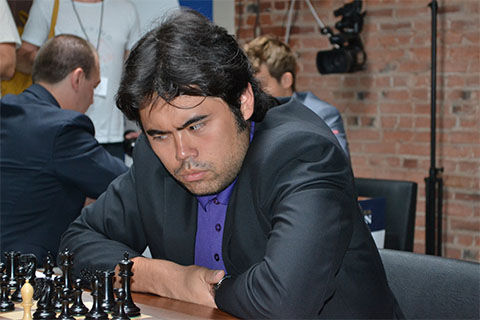
Chess players can be surprisingly expressive and no one embodies this better than GM Hikaru Nakamura. His reactions, both online and over-the-board, have become legendary in the chess world, spawning countless YouTube montages dedicated to his facial expressions alone.
Some of the most memorable moments include his priceless reaction to Levon Aronian’s opening blunder in the Caro–Kann against David Howell, his amused expression during the FIDE Candidates Tournament when Richard Rapport lost to Ian Nepomniachtchi, and of course, his stunned reaction when Magnus Carlsen blundered against Vincent Keymer in the World Cup (where Magnus ultimately went on to win in the tiebreaks against Praggnanandhaa Rameshbabu).
Ultimately, a player’s expressions, whether animated or controlled, form part of their unique identity at the board.
BONUS: Anish Giri stealing chess pieces
Mental health
Have you ever had a song stuck in your head right before a game, the one that keeps looping throughout, no matter how hard you try to focus? Or perhaps an old tune you haven’t heard in years suddenly resurfaces mid-calculation? If so, congratulations, you’re completely normal. If not, you might just be one of those rare players with absolute mental clarity at the board.
Now, let’s talk about the emotional side of chess which I feel every player, from beginner to grandmaster, can relate to.
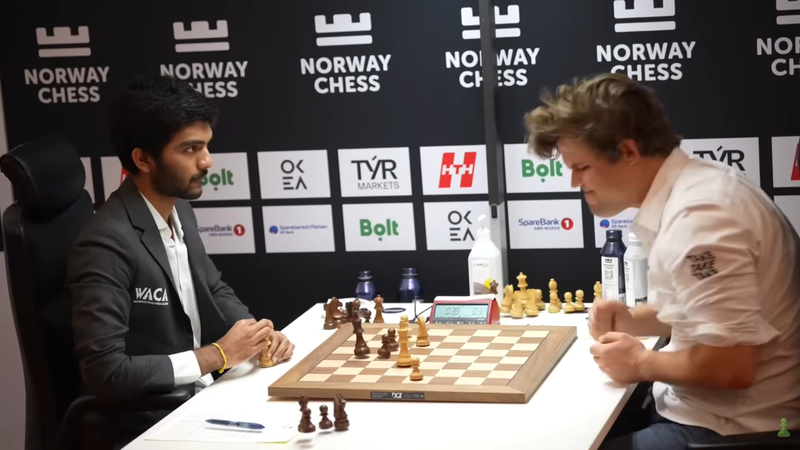
Losing a winning game online (whether by a last-second flag or an unfortunate blunder) can bring out emotions you didn’t know existed. Even the calmest and kindest players can momentarily lose their composure. From frustration-fueled sighs to slamming a mouse or muttering under one’s breath, we’ve all been there.
This isn’t limited to online play either. Over-the-board tournaments have seen their share of emotional outbursts. A classic over-the-board example of post-game tension was the heated verbal exchange between Nepomniachtchi Ian and Pentala Harikrishna.
Some players tear their scoresheets in frustration. As famously seen, when Christopher Yoo was disqualified from the U.S. Championships after his loss to Fabiano Caruana. Others might break their pens or dent their water bottles in anger. Even top players aren’t immune: Magnus Carlsen clapping in frustration after losing to Vassily Ivanchuk in the 2015 World Blitz, or Alireza Firouzja throwing his bottle after flagging in a nearly unlosable position, or banging the table alound after losing to Gukesh in the recent Norway chess. These are reminders that emotion is an inseparable part of competition.
While such reactions are understandable, it’s essential that they never disrupt others or diminish an opponent’s well-earned victory. Honestly, I think every chess tournament should come with a “demolishing room” . You know, a safe zone where players can go full Hulk mode after a heartbreaking loss. Smash a few fake trophies, throw some soft pieces around just get it out of the system. Better to break a chair in there than break your spirit at the board! If someone feels the urge to throw or break something, they could do it there, without harming anyone or disturbing the playing hall. It might just be the healthiest way to let all that pent-up emotion out.
Distractions, too, play a curious role in a chess player’s life. We can be deeply focused yet strangely forgetful at the same time. For instance, while preparing an opening, one might stumble upon a fascinating position and dive so deep into it, that the original purpose (preparing the line) is completely forgotten. It’s not exactly absent-mindedness; rather, it’s the intensity of curiosity overtaking routine.
And then there’s the question of ego. This is something every chess player wrestles with.
Losing to a lower-rated opponent can sting far more than we’d like to admit. When the defeat feels “undeserved”, it can ignite a desire for revenge or redemption that clouds our focus in subsequent rounds. The disappointment can be so consuming that it affects one’s performance for the rest of the tournament. In the end, chess is as much a psychological battle as it is a strategic one. The emotions like frustration, pride, obsession, even joy reminds us that behind every position on the board is a very human struggle to stay composed, focused, and self-aware.
Many chess players (including myself) dream about chess. Sometimes it could be so vivid that it feels real. After spending long hours preparing or playing, our minds stay stuck in “chess mode,” replaying moves and ideas even while asleep. We even experience lucid dreams, where we know that we’re dreaming but continue to analyze positions or play out games in our minds. It’s almost like the brain refuses to stop calculating. This can be both fascinating and exhausting. Before an important match, these dreams can turn restless — players might imagine different openings, tough positions, or even their opponent’s face. Instead of getting a good night’s sleep, it ends up mentally playing the game over and over again. While it shows how deeply connected we are to the game, it also adds to the pressure making it hard to truly switch off and relax.
The love-life
For most chess players, love can be a tricky game of its own. Since many of them tend to be introverted by nature, finding a girlfriend or even just putting themselves out there can feel nearly impossible. And when they do, it often ends up being someone from the same chess world. Others simply take the arranged marriage route.

Chess isn’t just a hobby. For professionals, it’s a full-time lifestyle. Hours of training, study, and constant travel leave very little space for relationships. Many players spend six to ten hours a day analyzing positions, preparing openings, or playing tournaments. So, if someone’s dating a chess player, they’ll need a good deal of patience and understanding. After all, for many of us, our first love was chess itself.
The emotional side of the game doesn’t help either. A big win can feel like pure happiness, while a painful loss can drain a player for days. That emotional rollercoaster often spills into their personal life too. Still, relationships between chess players tend to work best when both understand what the other goes through (the travel, the pressure, the long hours of silence before a game). That’s why we often see chess couples in the professional circuit as they just get it.
The lifestyle isn’t easy. Many players spend eight to ten months a year on the road, hopping from one tournament to another. Long-distance relationships become the norm, and balancing time zones can be a real challenge.
But despite all this, chess players are usually loyal and grounded when it comes to relationships. Maybe it’s because they understand patience, commitment, and the value of sticking with something or someone even through the tough situations.
Other fun facts
Some chess players have quirks almost as famous as their games. We can often spot them running a hand through their hair every few seconds, as if a brilliant move might drop out. Others nervously bite their nails between turns or shake their legs so hard that the entire table feels the tension. And when time trouble hits, their once-neat handwriting on the scoresheet turns into something so chaotic that even a doctor might raise an eyebrow trying to read it.
Then there are the intense ones. This categeory includes players who stare at the board (or sometimes straight through their opponent) with such focus one would think they could bend the pieces by sheer willpower. Some lean back dramatically after every move, pretending to be calm while quietly panicking inside. We can see them mumbling lines under their breath, raising their eyebrows in disbelief, or slapping the clock like they’ve just conquered time itself.
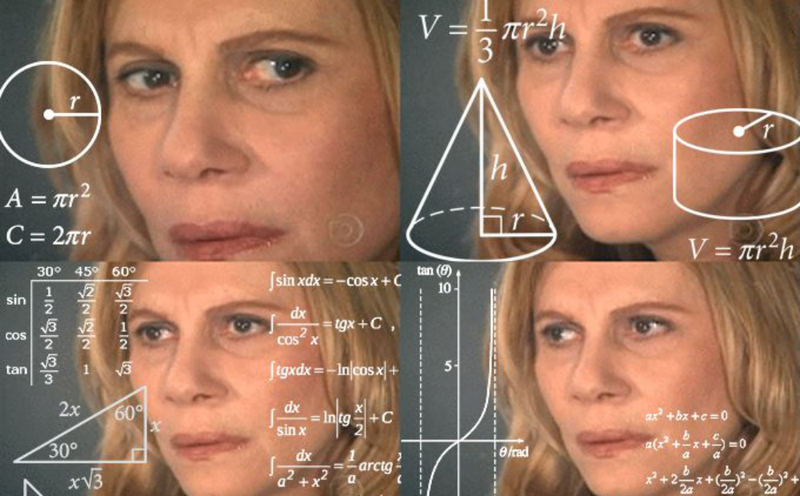
And, of course, there’s the classic ceiling stare — that faraway gaze during deep calculation, as if the next move might be written somewhere in the lights above. (Sure, they’re visualizing blindfolded — but still, it’s quite a sight.) Interestingly, studies suggest that when a player looks left, they’re recalling past moves, and when they glance right, they’re already mapping out the future. Lastly are the nervous coffee sips and those subtle self-congratulatory nods after spotting a winning tactic.
Sometimes, chess players have the funniest reactions over the board. These are moments that make no sense to anyone watching. You’ll see one suddenly grin after blundering a tactic, or burst into laughter mid-game as if they just remembered the world’s best joke. In reality, they might be replaying a meme in their head or thinking of some absurd position that popped up in analysis. To an outsider, it looks completely random, as if they’ve lost track of what’s happening. But to their opponent, it’s downright confusing.
Why is he smiling? Did he see something I missed?
That little smirk or laugh can unintentionally throw the other player off balance. Chess players might not mean to play mind games, but sometimes their own thoughts are funny enough to do it for them.
Oh, I almost forgot to mention this — when a chess player wins a beautiful game, the joy lasts long after the final handshake. They can’t help but relive every move, excitedly explaining the twists, turns, and brilliant ideas to their friends, coaches, or really anyone willing to listen. Their eyes light up as they describe the critical moments, the sacrifices, and the turning points that led to victory. It’s not just the result that matters — it’s the story behind each move that fuels their excitement. For days afterward, they might replay the game in their head or on a board, savoring the feeling of having created something truly special. That quiet pride shows in how they walk, how they talk (a glow of satisfaction that every chess player understands).
Bucket list
One might assume that getting into a relationship would be a bucket-list item for a chess player. But a chess player's obsession is unique, and the bucket lists vary widely depending on the role within the chess world.

- Take chess content creators or authors of opening courses on platforms like Chessable or ModernChess. For them, a top-tier bucket-list dream is often to create a signature or trademark opening. Anna Cramling is a good example as she “invented” the now-famous 'Cow Opening'. Some authors would even want to pubish a book of their own.
- To those who loves travelling, their main wish would be to travel as many countries as they could to get the maximum number of stamps in their passport.
- Some professionals chase fame. Others dream of becoming national champions year after year. A few aim to break long-standing records — like Magnus Carlsen’s impressive 125-game unbeaten streak in classical chess. Many players long to win a major classical event, and almost everyone shares one bucket-list fantasy: playing a truly perfect game, the once-in-a-lifetime masterpiece.
- Coaches have their own dreams too. For many, the ultimate bucket-list achievement is to see even one of their students rise to the level of a well-known Super-GM.
- Bucket lists also differ by playing strength. Older, passionate amateurs in the 2000–2100 range may still dream of earning the FM or CM title. Players stuck around 1900 might give everything just to cross the 2000 Elo barrier. And those lingering near 2700, but not quite there, often yearn simply to see their rating push past that magical line — even if only for a single day. Nihal Sarin is a recent example: after hovering around 2690 for a long time, he finally broke into the 2700 club.
- Others measure their goals through rivalries — settling long-standing scores, beating their nemesis, or overcoming an opponent they’ve never been able to crack.
- Online chess lovers would have a rating target as a huge goal. Reaching a sky-high rating like crossing 3000 in Lichess blitz or bullet is an enormous achievement and a cherished goal for many.
Burnout
Burnout in sports/games is a state of physical, mental, and emotional exhaustion that develops when an athlete faces prolonged stress without enough recovery. It builds up slowly, often unnoticed, until performance drops and motivation crashes. Just like any other sport burnout is the same in chess. Studies claim that burnout is a psychological syndrome caused by several factors that include chronic training stress, high expectations, constant competition pressure, and insufficient rest. It often affects athletes who push themselves relentlessly — or are pushed by coaches, parents, or the competitive environment.
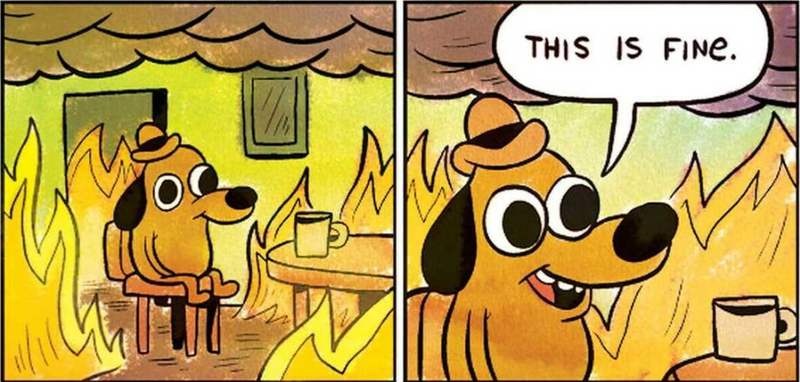
In chess, I would say that financial pressure is one added factor that influences burnout the most. Chess players are mostly "not rich". This means that failing to prove/succeed would mess up one's mind badly, ultimately leading to burnout (giving up on the game for good). The other factors that cause burnout are:
- Emotional exhaustion: losing the emotional energy needed to compete or train.
- Reduced sense of accomplishment: Even when performing well, they feel like they aren’t good enough. Their confidence drops, and they stop enjoying the process.
- Devaluation: The love for the game fades where training feels like a burden, not a passion.
- Unrealistic pressure: High expectations from the player himself/herlself puts constant pressure & makes the game feel more like an obligation than a choice.
- Fear of failure: Some players burn out because the fear of losing becomes overwhelming.
So, the next time you watch a chess game, remember that it’s not just about strategy and calculation. Behind every calm face and silent move lies a world of quirks, rituals, and emotions that make chess players wonderfully human. It’s the little things like these that make chess players fun to watch and even more fun to understand.
Like I mentioned at the beginning, I outsourced only max 5% of the information.
I hope this was fun to read!
You may also like
 IM adapodadeiii
Revisiting the heated encounters between Magnus Carlsen & Sergey Karjakin
Here I have analyzed four intense and iconic games played between Magnus Carlsen and Sergey Karjakin IM adapodadeiii
Rebirth: A Fresh Addition to the Game of Chess
Tired of having to march your pawns all the way to the 8th rank just to get a queen? Well, I’ve come… IM adapodadeiii
Some more Chess Riddles
Back Again! — with some more chess problems that anyone can attempt CM HGabor
How titled players lie to you
This post is a word of warning for the average club player. As the chess world is becoming increasin… thibault