
https://www.youtube.com/@martin10s48
Game #24 - Aggressive with the English
Super Eval - Correspondence Game #17
Announcement:
- As you saw in my last Twitter/X thread, I successfully beat Stockfish in a game that took exactly 70 moves in Game #25 using the new algorithm I was talking about, the rule of ratios. I will publish that article this evening, but until then, let me show you the 24th game in which I got a bit too aggressive with my plans of attacking the opponent's king before closing the center.
- By the way, to those of you who are wondering how I hide the engine moves during my games against Stockfish on chessUI, when you right-click on the page and click inspect, the inspect window appears right on top of the computer line. And the evaluation shown on the site is not the true evaluation we normally use. So seeing that during the game is not that useful, even though the inspect window covers it too.
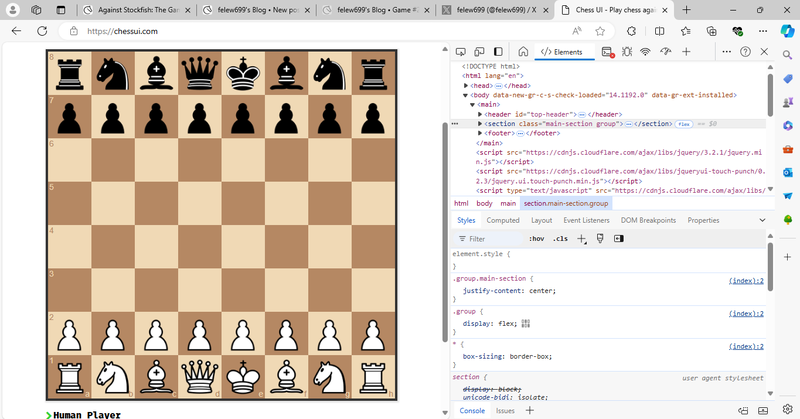
- And of course, taking takebacks just to beat Stockfish and be famous is not my goal. I am trying to improve my overall play while helping you make progress in your game. Takebacks and external assistance won't do any of that. So please know that your Black Bird is playing fair and is not just pretending to be a strong player. Felew is a widely accepted player in the real world with a 2000+ FIDE rating.
The Game
Continuation of the Super Eval saga:
Aggressive with the English:
Game #17 analysis:
Lessons from this game:
> Close the center before initiating flank attacks (22.Ng3?!)
> Efficiency matters when attacking the king (22.Ng3?!)
> Giving up in chess is the worst thing you could do (28.Qf2??)
Super Eval
Super Eval is a system in which you take in the situational conditions, categorize the positions as dynamic or static, and then use the relevant method for each position.
Situational Conditions
Situational Conditions in a tournament game can be divided into 3 main categories. They are:
1. Board Situation - Comparison of No. of Hanging pieces, King Safety, Alignments, Material, Controlled Squares, Mobility, and Pawn Structure
2. Clock Situation - Comparison of Time available per move
3. Psychological Situation - Comparison of Tournament pressure, Spectator pressure, Rating anxiety
Evaluating the situational conditions correctly requires a lot of experience. This is more of an artistic approach to chess rather than a theoretical approach. For this blog series, I will only be explaining how to cope with the board situation.
Dynamic or Static?
This decision is not that difficult to make. The theory is, that if there are tactical weaknesses in the position (Hanging pieces, King Safety, Alignments) then the position is dynamic. If the position doesn't have any tactical weaknesses, then the position is static. If the moves that exploit the tactical weaknesses in a dynamic position do not work, then it's also a static position.
Now that we've decided between a dynamic and static position, let's look at each one of them.
Dynamic
If the position is dynamic, you have to switch to the MCTS. The description of the MCTS can be found at the bottom of the article. But if you realize that the moves exploiting the tactical weaknesses do not work (i.e. do not give you a better position after using the MCTS), then you have to consider it to be a static position.
Static
If the position is static, you should start making a plan related to the situational conditions. More than anything else, this requires knowledge and experience. I won't discuss how to make a plan in this article because you can find plenty of other books and articles that teach you how to make a plan. Once you have a plan, you should make sure you have picked the best plan. To do this, you can use the rule of ratios. You can also use the rule of ratios to find the best move from your list of candidate moves.
Rule of Ratios
The method for picking the right plan and choosing the best move from your list of candidate moves.
For plan selection
If you see a couple of plans for one position, you can use this method to find the best plan out of them. To use this method, first, you see how effective your plans will be if they succeed. You evaluate the kind of dream position you are trying to get with your plan. The total "effect" of your plan. Then you try to understand the counter chances of your opponent. What can your opponent do to stop your plan? Can they start their own attack on a different side of the board? Does this plan create weaknesses in your position? Once you understand these factors, you calculate the "drawback" of your plan. Then you pick the plan with the highest Effect: Drawback ratio with the effect side being higher.
For move selection
To find the best move from your list of candidate moves, just like in the rule of ratios for plan selection, you can evaluate the Effect: Drawback ratio of those moves. And you play the moves that have the highest effect-to-drawback ratio (with the effect side being higher). However, the method of evaluating the effect and the drawback of moves is different from the method used to evaluate the effect and the drawback of plans. To evaluate the effect and the drawback of a move, you have to evaluate the Attack: Defence ratio of your effect or drawback. For drawback, this means how much attack from the opponent is there compared to your defense of the drawback. For effect, this means how good is your attack/effect compared to the opponent's defense against the square or piece you are having the attack/effect against. Again, this method is artistic. It's not entirely theoretical. So if you are going to use this method, perfecting it with knowledge and experience is your duty. Now I'll give you the method you should use in dynamic positions.
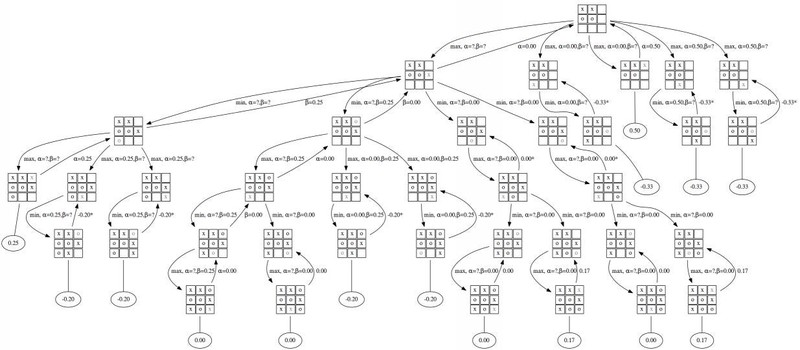
Monte Carlo Tree Search
The MCTS is the method for dynamic positions. It goes as follows:
> First, we take a list of candidate moves and see which moves are most preferred by our intuition.
> Then we make a play-out (a.k.a roll-out) by applying the same principle from our opponent's side and evaluate the position when a static position is reached.
> Then we take the average of the so-found leaf positions to assign a value to the calculated candidate move.
> Then we repeat the process for all the candidate moves and compare the move values to conclude the best move.
When using this method, it's important to broaden your list of candidate moves rather than going deeply into one line. Going deeply into one line can make you miss simple moves available for your opponent that would give them the advantage. In doing so, you also run the risk of missing moves that would have simply granted you a better position. This was well proven in the game Glance at everything. In situations where you don't have enough time to glance at everything, just glancing at the intuitional moves is acceptable.
Thank you to all of you who stuck with me so far in my journey. Your support means the world to me. I recently got a digital camera for recording videos for YouTube. So it'll be much easier for me to record my videos. Also, I found out that editing with Microsoft Clipchamp doesn't leave a watermark on the videos, so editing won't be a problem from now on. I will let you know when I upload my first video. And remember that day won't be too far.
External links
YouTube: https://www.youtube.com/@felew699 (No videos yet. I am still working on it)
Twitter: https://x.com/felew699
Chess.com: https://www.chess.com/member/felew699
Reddit: https://www.reddit.com/user/Felew699/
Against Stockfish: https://lichess.org/study/2guM490P
Opening Study: https://lichess.org/study/xeTeuu3A
Special Thanks to...
Grammar Editor: https://app.grammarly.com/
Game playing site: https://chessui.com/#
Practicing and blog writing site: https://lichess.org/
You may also like
 FM felew699
A Time for A Change
The Reason for My Silence, and The Shift of My Beliefs FM felew699
A Modern Classification of Chess Positions
A perspective on chess as a whole and a modern way of classifying positions for the ease of interpre… FM felew699