
Witalis Sapis
The disappearing move - Weakening the opponent’s position
The concept of the maneuver is that a piece forces the weakening of the opponents’ pawn structure or worsening his placement of pieces, before it lands on the square it really aims for.Strategy - the magical side of chess.
1.4. The disappearing move
The concept of the maneuver is that a piece forces the weakening of the opponents’ pawn structure or worsening his placement of pieces, before it lands on the square it really aims for. Usually, the maneuver is performed by a bishop, for example Bc1-g5-e3. The maneuver is similar to “the shuttle”, with the difference being that the piece doesn’t back to the original square.
Macieja Bartlomiej - Karpov Anatoly
Warsaw (Poland) 2003
https://lichess.org/study/XiGLMJhl/LxmPmU5e#0
Black to move
With 1...Bf5 2.e4 Bg4, Black weakens his opponent’s control over the d4 square and trades the knight that protects this square.
Sapis Witalis - Jensen Jacob
Cappelle-la-Grande (France) 2003
https://lichess.org/study/XiGLMJhl/qfNCx7fQ#0
White to move
White intends to move the d1 knight to c4 via e3, thus the dark-square bishop needs to free the square. We can play 1.Bf2, but it is much better to begin with 1.Ba7. The bishop will eventually reach f2 anyway, but the black rook will be displaced.
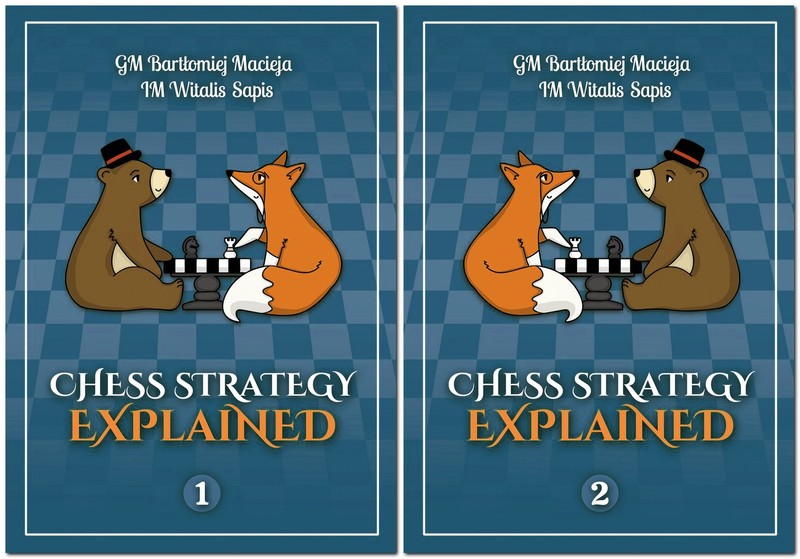
("Chess Strategy Explained"-Bartłomiej Macieja Witalis Sapis- Sawit 2021)
"These strategic manuals by two experienced trainers are a must for any instructor! I recommend using them for students with USCF ratings ranging from 1300 to 2500. I have read many instructional books since my junior years but never have I come across such an easy-to-digest way of presenting examples—only a few moves with simple, clear verbal explanations of the ideas from the players themselves! The examples used vary in level of difficulty and going through all of them will only solidify one’s strategic understanding. The exercise chapters (Chapter 3 for Vol 1 and Chapter 7 for Vol 2) add more instructive value as it can be used either as in-class group exercises or individual homework. Any club leader, camp instructor or chess coach will be able to find the topical chapters useful when preparing for their regular lessons. And I won’t be surprised if they improve their strategic intuition as well in the process!”
GM Julio Sadorra
Coach of University of Texas Dallas Chess Team
You may also like
 IM itore
Advantages of chess
Today is a Christmas present. Text about what we can gain by playing chess. This is also one of the … IM itore
My search algorithms move
My search algorithms move IM itore