
3+0 vs 3+2 the difference?
a brief time analysisBefore reading this post
The games in this analysis were lichess-annotated 3+0 and 3+2 blitz games from June 2023. More about the data can be found at the lichess open database. Players with more than 5 games on both time format was selected for the later analysis.
Players preference
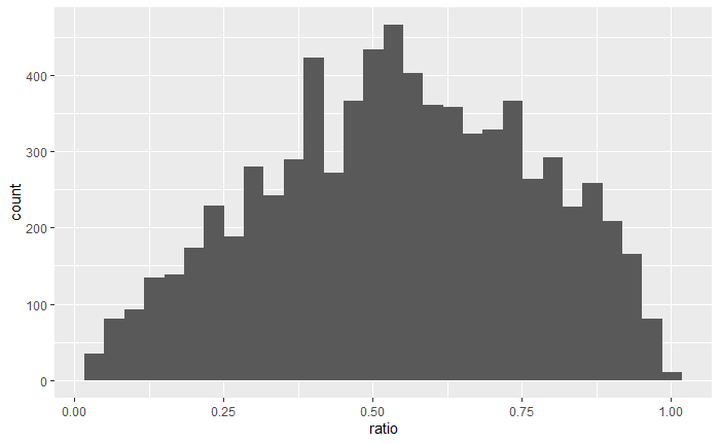
We can look at the distribution of players' preferences for 3+0 vs. 3+2 games. The graph below shows the ratio of 3+0 bullet games played (1.0 is only playing 3+0 games, 0.0 is only playing 3+2 games.) Most people preferred 3+0 games over 3+2 games. Some extreme cases involved 945 3+0 games and 5 3+2 games. One player played 223 3+2 games and only played 6 3+0 games.
Time management differences in 3+0 and 3+2
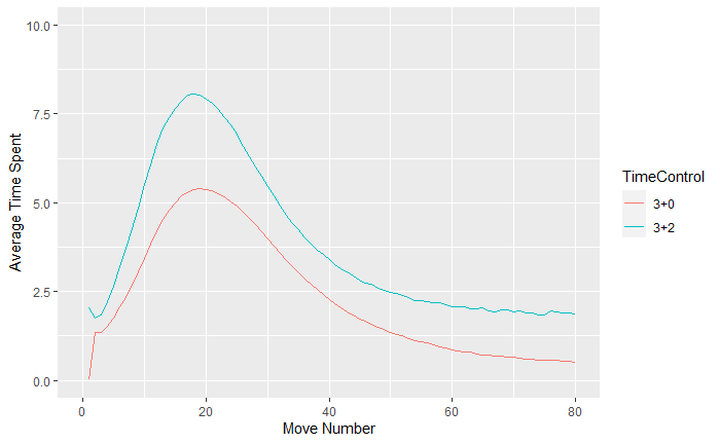
The most straightforward expectation might be for players to use 2 seconds more for every move. This seems to be true in the middle game around move 20. However, for openings and endgames, 3+2 games only use around 1 second more than 3+0 games on average.
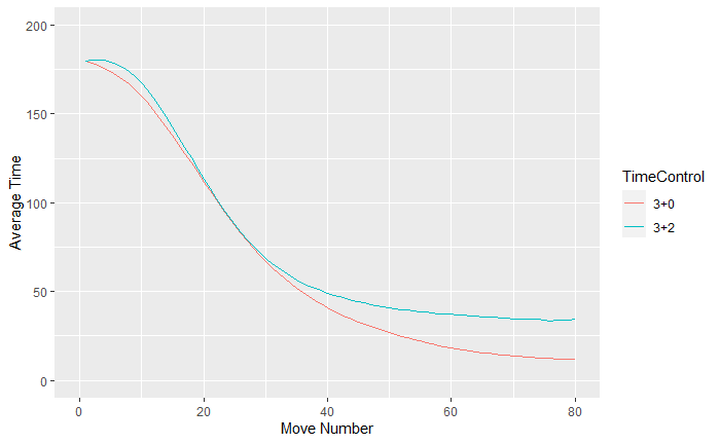
We can also look at the relationship between the average time left and move numbers. The interesting part of this graph is that on average middle game, 3+0 and 3+2 have the same time left.
Long thinks in games
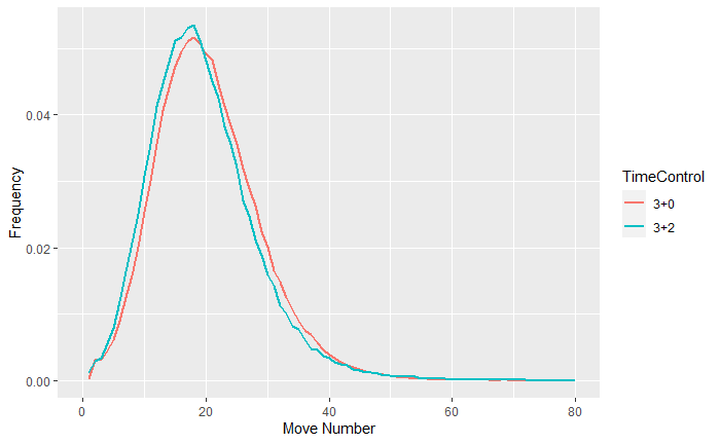
When do people spend the most time in games? I found out that it is very consistent in both time controls. The following graph is the distribution of the longest time spent on a move. The maximum lies around move 20 which also has the highest average time spent.
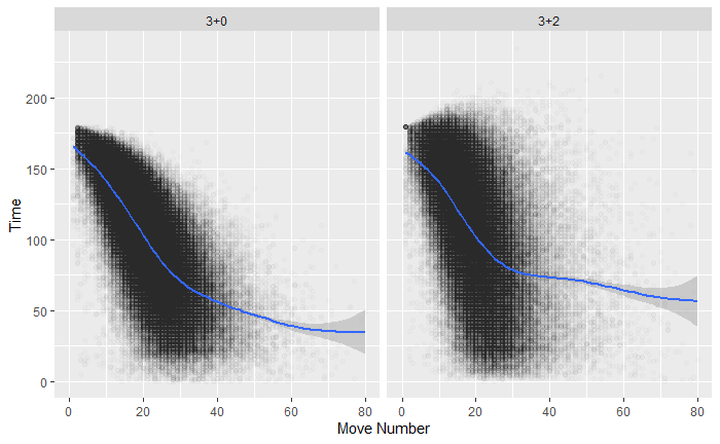
We can also see this graph with time as the y-axis. The distribution is very similar except for the fact that 3+2 have some points above 180 in move number 0-20. There is also a trend of higher time left on 40+ but the frequency of these cases makes the trend not significant.
Move Type analysis
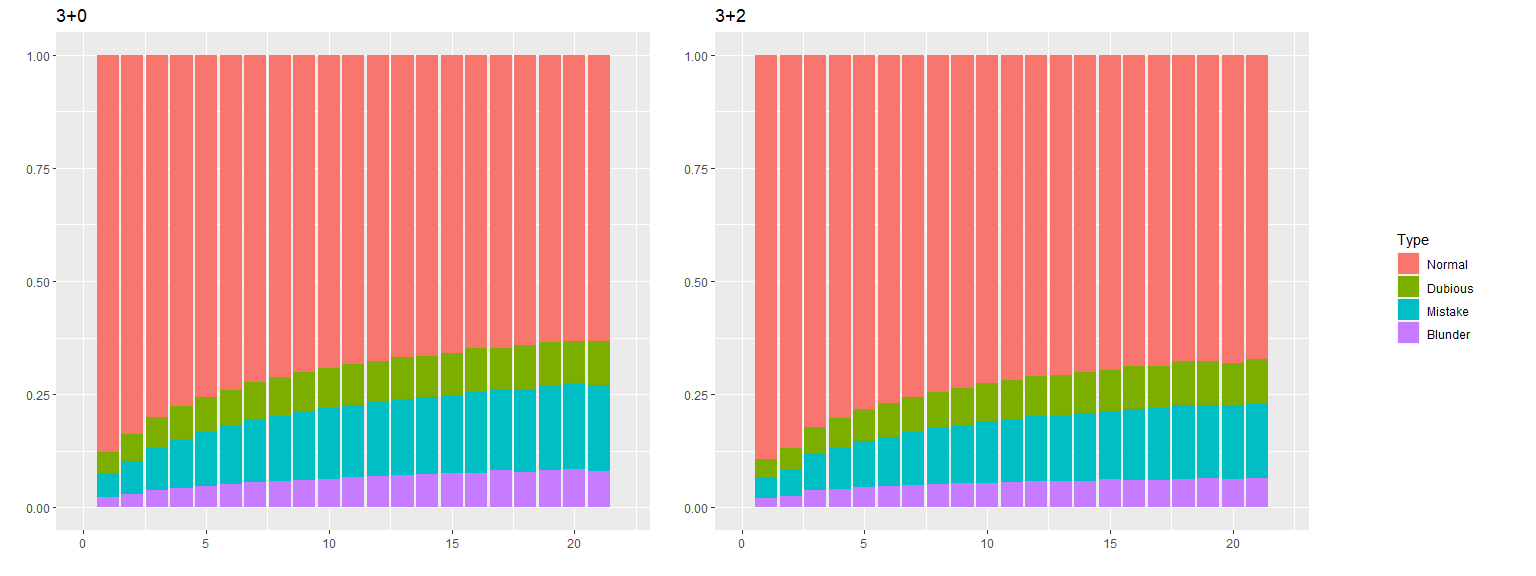
If we are spending more time on a move, are we making better decisions? There actually is a significant difference when moves are grouped by time spent. The proportion of normal moves is higher in most cases up to 20 seconds spent on one move. In the following graph, you can look at the x-axis (Time Spent) and see the proportion of move types on the y-axis. (If you want to see the image better, you can open the image on a new tab)
Blunder rate by a player on 3+0 vs 3+2
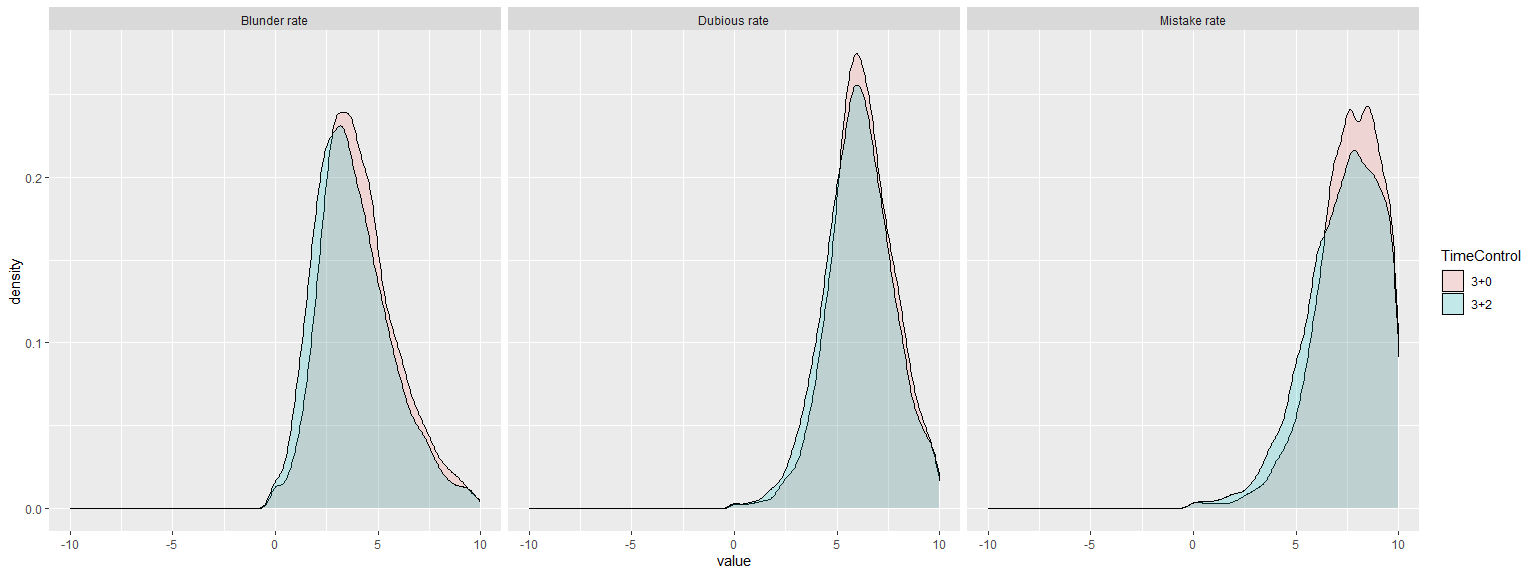
However, this can't suggest that people blunder less in 3+2 time control. I grouped moves by a player and analyzed their blunder rate on each time control. (If you want to see the image better, you can open the image on a new tab)
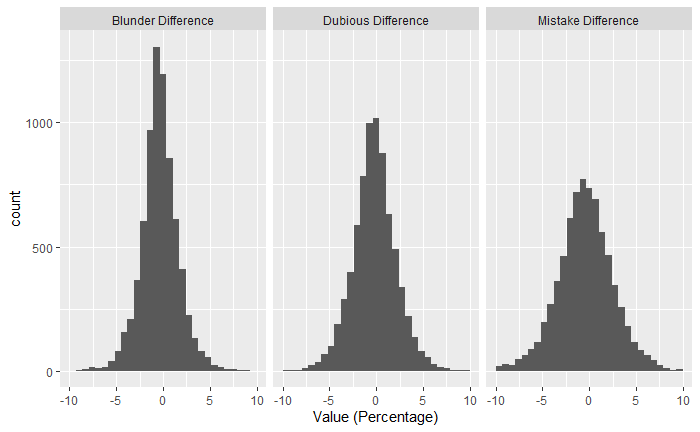
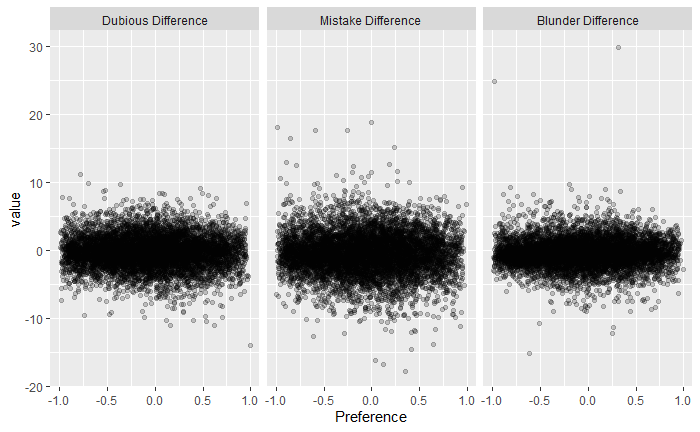
Now that we know the dubious, mistake, and blunder rate of each player by each time control, we can subtract and see the difference between them. The following graph is the rate difference 3+2 - 3+0.
We can see that these differences are left skewed meaning the dubious, mistake, blunder rate was higher in 3+0 games than 3+2 games for most players.
There might be some argument about the preference of time control having an impact on the blunder rates but that seems to be consistent over preferences. -1 is people who solely play 3+0, 1 is people who solely play 3+2 time format.
Future post
I might do another analysis in this 3+0 and 3+2 dataset. It might take some more time. If you have any questions or suggestions about my post feel free to leave it in the comments.
You may also like
 oortcloud_o
How long is an opening?
A new approach on where opening ends oortcloud_o
Which openings are related?
simulating opening connectivity graphs with known techniques oortcloud_o
Cheater gameplay? - part 1
How do they differ in 1+0 Bullet games FM CheckRaiseMate
Openings vs. Ratings
How your opponents' tendencies change as you climb the rating ladder GM NoelStuder
Bishop vs Knight In Chess: A Grandmaster Guide
Bishop vs Knight: the most common imbalance in chess. But when is it better to have a Bishop? And wh… oortcloud_o