
Engaging healthily with chess: an Acceptance and Commitment therapist's guide
Note: the correctly formatted version of this article is posted on my Substack here. I've adapted a bit of the language and formatting to post it here on Lichess. Please like and subscribe on Substack if you like it!
Preamble
Chess is very painful (you can skip this if you agree)
I am a therapist-in-training and amateur chess player. I’ve been playing the game since I was a kid, and while I’m a fairly average player (I’m in the 1700-1800 rating bracket OTB - and about 1800-2000 on Lichess - which makes me an average club player), I have a lot of experience with chess in all its formats. In this lifetime of playing chess, I’ve seen a lot of joy, but also a lot of pain. This pain takes many forms.
One of the best (and worst) things about chess is that almost all of the time, you alone are responsible for what happens in your game. Yes, chess is a two-player game, and what your opponent does matters, but you have complete control over how you respond to it. If you lose, it’s entirely because you let your opponent get the better of you, and there is no one you can blame but yourself. Many of the best chess players believe that chess is a draw when played perfectly, so losing means that you must have done something wrong along the way.
Sure, in some rare cases, you might be playing online and have a bad connection, or maybe some rules were broken during an in-person game and the arbiter (referee) incorrectly enforced them. But in the vast majority of cases, the single biggest determinant of a chess game’s result is how well you played (relative to your opponent). And in classical chess games, where each side typically has hours to spend thinking about their moves, you have to make decisions knowing that a single wrong move can make or break the result of the game. I have made many such mistakes...
Think about how unusual a situation this is! Real life is complicated, and responsibility is difficult to assign accurately. When things go wrong, we can (and often do) blame many things other than ourselves for why the situation went badly. But in chess, you bear the unique responsibility of knowing that the only reason is because you were worse than your opponent. For people with a fragile self-image, that can be soul-destroying.
Speed chess (which usually ranges between 25 to 1 minute(!) per side) presents another source of pain. Very often, people lose in these formats because they ran out of time before they could complete the game. Sometimes, these losses can be tragic - perhaps Player 1 was completely winning on the board but lost because Player 2 played aimless moves until Player 1 ran out of time. These sorts of losses can also be very sobering for older chess players, since players lose their processing and mechanical speed as a natural result of aging. Check out the legendary Vasyl Ivanchuk, aged 56, pouring out the pain from his very soul after losing by running out of time in a chaotic game against his much younger opponent (reaction begins at 9:46; note also his opponent’s intense emotions in the final moves before the result):
Yet despite this pain, millions of people across the world play it on the regular. Chess.com, the dominant online chess website, boasted of 11 million unique daily active users in 2023. The International Chess Federation listed 360 thousand active over-the-board tournament players as of 2017. These people are clearly willing to risk the pain, all for something that an overwhelming majority - even the professionals - don’t even do for money or fame. It is well known to chess insiders that chess is largely unviable as a career for all but the strongest players.
So why do they do this? Perhaps chess is an addiction, and addicted people do things that hurt themselves. I actually think this is true for some people, similar to how video game addiction is slowly gaining mainstream acceptance as a disorder. But that cannot explain everyone’s participation in chess. Plenty of people do not experience the symptoms of addiction with chess - like withdrawal symptoms, preoccupation with the game, giving up other activities, or risk jobs or relationships because of the game.
More simply, it’s because we value it. Values, loosely defined, are things that we care about intrinsically - we have no deeper reason for caring about them, they are simply good in themselves to us. Doing things that we value gives our lives meaning, and doing what we value despite our pain is arguably what a healthy life looks like. So we play chess because we value it despite the pain.
We often hold onto this pain, and at great cost...
There’s not enough quality research on chess and mental health, unfortunately, but here are a few examples that most chess players will recognize in themselves or others:
- Chess burnout can happen. Much like burnout in general, players can start to lose interest in chess, feel very tired, have mood problems. And it can lead to players quitting chess, as this blog post by a master-level player discusses.
- Emotional dysregulation. Most chess players will have seen this in some kids when they lose - tantrums, screaming, running off crying. They’ll also have seen these behaviors in a surprising number of adults. Chess is stressful, and the stress can translate into emotion regulation problems.
- Wildly unstable self-beliefs. Many a player will oscillate between I’m the greatest player in the world to I’m the worst player in the world depending on the results given. It can reflect very strongly on their self-worth - certainly for professional players, whose livelihoods depend on their abilities, but also many amateurs who wed their sense of self to their performance in chess.
See this quote from a top level player:
I have very little positive feedback from playing chess. What dominates is the negative—won games don’t give me any feeling of satisfaction and wasted opportunities, such as at the Olympiad, where I drew with Dragnev like an idiot...
Grandmaster Jan-Krzysztof Duda
This phenomenon gives me the perfect excuse to describe a therapeutic approach I apply with my clients - one that I think will be VERY helpful for chess players.
Can we learn to not hold onto that pain?
Luckily for us, there’s a model of psychological health - and a corresponding therapy that I practice - that fits very neatly with this. It suggests that while the world is full of natural pain, a normal part of our lives, we need not engage in mental processes that make us suffer further. It provides us with an orientation to life that helps us to keep doing what we value despite the pain. It’s called Acceptance and Commitment Therapy (ACT), and it centers psychological flexibility as psychological health. Here’s a useful diagram:
https://substackcdn.com/image/fetch/$s_!Q8WT!,w_1456,c_limit,f_auto,q_auto:good,fl_progressive:steep/https%3A%2F%2Fsubstack-post-media.s3.amazonaws.com%2Fpublic%2Fimages%2Fe4117eca-a2f8-4544-8a2a-2251e34edec1_1000x774.jpeg
Source: https://svenschild.com/blog/f/understanding-the-six-act-pivots-of-the-act-hexaflex
For the rest of this article, I will attempt describe the practical applications of ACT for players of my favorite game. This is a huge topic, so covering it could range anywhere from this article to a whole article series. So I’ll do it like this: if folks are interested enough in this article (i.e., people express interest, views, likes, etc.), I’ll expand it into a longer series. I’d love to see feedback on what about this article interested you or if there’s anything you’d like me to expand on!

What is ACT about?
ACT is a therapy that focuses on helping people build a meaningful life, identifying typical mental dysfunctions that get in the way of that, and addressing those dysfunctions. It is what many call a third-wave behavioral therapy - a therapeutic approach grounded in our most rigorously-tested theory of human functioning, behavior therapy, but one that integrates our best available knowledge of mindfulness, acceptance, emotions, and language. As you can see from the diagram above (that we will refer to from now on as the hexaflex, its official name), six of the core dysfunctions are listed in pink:
- preoccupation with the past or future (Past/Future Orientation)
- avoidance of difficult experiences (Experiential Avoidance)
- identifying too strongly with your thoughts and emotions (Fusion)
- having too rigid an understanding of yourself (Self-as-Content)
- difficulties with taking action (Inaction)
- lacking clarity on what directions you want to take in life (Lack of Direction)
These, and the ways in which these interact between them, are thought by ACT to explain a wide array of psychological problems. Its mirror image, in turn, is thought to be a model of being psychologically healthy:
- focusing your attention on the present and current experiences (Present Moment Awareness)
- willingness to fully experience difficult things without suppressing them or moving away from them (Acceptance)
- having the ability to let go of thoughts/feelings whenever useful (Defusion)
- being flexible in your understanding of who you are (Self-as-Context)
- the ability to initiate and follow-through on intentional choices you make (Committed Action)
- being clear about where you want to go in life (Values)
So with these in mind, I will spend the rest of this article describing how they can help us chess players engage more healthily with chess! Here’s another useful Hexaflex diagram I’ll draw from, this one organizing the six processes into three clusters: Open, Centered, and Engaged*.*
https://substackcdn.com/image/fetch/$s_!d8HY!,w_1456,c_limit,f_auto,q_auto:good,fl_progressive:steep/https%3A%2F%2Fsubstack-post-media.s3.amazonaws.com%2Fpublic%2Fimages%2Fbd4b22a9-fdf6-47b9-a621-be45e2b1cc94_640x701.jpeg
Source: Djikstra & Nagatsu, 2022
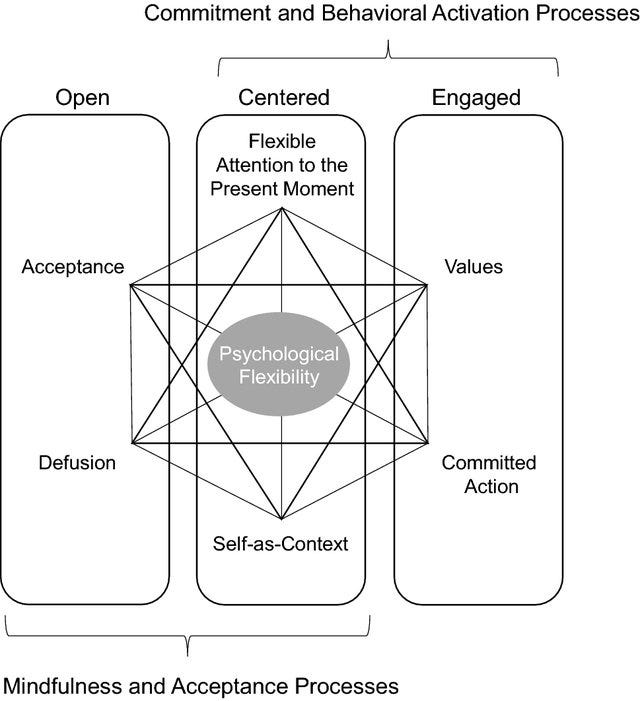
One more quick note: What I mean by “Useful”
In many ways, ACT is centered around the Values piece the most. It takes a rather unusual stance to the idea of truth, one that many people initially have trouble accepting. It distinguishes between “capital-T Truth” (the idea of objective reality) and “small-t truth” (what is helpful for your values). We apply all of the processes of the hexaflex in service of small-t truth. We may have thoughts that are objectively true, but are they useful for our values? If not, why should we hold onto them? Why “buy” them? ACT says that if it’s not useful, we may as well discard it.
Again, a difficult pill to swallow for many, but I have an example that might help.
Let’s say that you find yourself stuck on a window ledge on the 7th floor of a tall apartment building. You want to live. There’s a fire escape not too far away to your right, where you’ll be safe, but you’re going to have to be very careful with your footing as you slowly shuffle your way towards it. You also can’t see your footing very well, so you’ll need to rely on some help from others down below.
Now let’s say there’s a guy down below who’s yelling at you. He’s telling you that on average, people who fall from a 7th floor height have a 90% chance of dying. He’s saying that you’re not very athletic, and so your chances of finding your footing and making it to the fire escape are pretty slim. He’s loudly describing all the different splatter patterns that your body and the blood within it might make on the pavement if you fall. Everything he’s saying is factually true - but it’s not all that helpful, is it? The people you actually want to listen to are the ones telling you if your next foot placement is too high or too low. He’s drowning them out.
I think you get the idea. In the context of mental health, whether something is an objective fact isn’t the only criteria for deciding its usefulness. You’ll want to recognize what your values are, whether a thought is useful or unhelpful for it, and then decide how you want to engage with that thought. So usefulness is the criteria here, not truthlikeness. Keep that in mind as we walk through the different ACT processes.
Open
Definitions
Acceptance: Voluntarily adopting an intentionally open, receptive, flexible, and nonjudgmental posture towards moment-to-moment experience
- In other words, choosing to embrace to the experiences of life without judgment.
- This improves flexibility of behavior by allowing us to engage with the things we want, rather than let our fear of pain or distress force us to avoid them.
Defusion: Increasing psychological distance from thoughts and emotions by observing them as transient mental events rather than accurate representations of reality rather than directives to be obeyed.
- In other words, changing the way you relate to thoughts by learning how not to give them weight.
- This improves flexibility of behavior by giving us some control over how our thoughts and emotions affect us, rather than have them control how we respond.
Examples of Closedness in Chess - and how to be Open
Buying into negative self-beliefs about our chess-playing
What we do: Because chess is a game where the players have so much control over the result, the “it’s my fault” and “I really suck at chess” thoughts are inevitable. You will have thoughts about how bad you are at chess when you perform badly. Maybe it’s even objectively true - maybe you’re consistently performing much worse than your rating suggests you should. Or maybe you’re a club player and losing games to your club rivals much more than you used to. It’s extremely embarrassing and you feel deeply ashamed.
What do you do with these beliefs? In the unhealthy case, we’d simply internalize them. We would fully buy into the fact that we’ve lost our mojo, all the things that make us tick. We believe with a heavy heart that our friends are getting much better at chess than us and we’ve reached the limit of our potential. We might become, as the chess GOAT Magnus Carlsen once called an underperforming former world champion, “broken”, losing all confidence in our abilities. We would take these beliefs and say “this is who I am”. And when our chess-playing is tied up very closely with our identities, as it is for some, losing it can feel like losing what makes life worth living.
What to do instead:
Learn how to not buy into your beliefs when they arise. Remember the metaphor of the guy yelling at you as you’re clambering to the safety of the fire escape? That guy is the part of your mind saying unhelpful things to you. So you disengage from the Mind/Guy, ignore him and pay attention to the ones who are telling you helpful things.
Very importantly, you’re not yelling back at the guy. You are simply paying him no mind at all, and his words become meaningless to you. We call this defusion. Here’s one concrete way to do this (I borrow this exercise, called the “Milk, Milk, Milk” exercise, from Steve Hayes’ Get out of your mind and into your life book):
- Pick out a word the guy is saying to you that, if you paid mind to it, would hurt you a lot. Maybe the word is “useless”, or “failure”, or “weak”, or “patzer”.
- Repeat that word to yourself - out loud if you’re alone, or in your head if you’re with others - over and over again. Keep saying it until you start to perceive the word more as a sound than a meaning.
- Vary the way you do this - maybe you emphasize a particular part of the word, maybe you try and say the word with different pronunciations or accents, etc.
- The more you do this, the less the word will start to matter to you. It’s just a word! Words mean things, but they don’t have to mean things to you.
Avoiding certain aspects of chess (e.g., formats, tournaments, venues, opponents) because the emotions that they cause in us are too distressing
We’ve all had bad experiences in our chess-playing lives. I remember one of my worst - it was in the scholastic national championships, and I was playing my final game where a draw would have made me eligible for the national youth squad. No prizes for guessing the result. I remember thinking about this tournament for years afterward, and lamenting all of the opportunities I didn’t get because of that stupid result. I distinctly remember how I never played in that tournament venue again because I didn’t want to be reminded of that loss. To this day, I dread the final rounds of every tournament and don’t really want to play them.
In its extreme form, we call this PTSD, or posttraumatic stress disorder. One of the major symptom clusters of PTSD is avoidance - typically avoidance of the stimuli/aspect of the traumatizing situation. Some theories of psychological trauma argue that the avoidance of the stimuli is the primary factor that sustains PTSD, because it prevents us from processing (“making sense of”) the traumatic event. How can you understand what the difficult experience means to you if you refuse to think about it?
I’m sure that at least a few folks reading this might resonate with this extreme reaction - but for the vast majority of you, it will look more benign. Maybe it means we take a bye (i.e., a planned game skip) in the final round because of this fear. Or maybe we avoid playing rated classical chess because it makes us feel stressed. Maybe we refuse to play casual games with players better than ourselves because losing makes me feel like a failure, and winning (even against far-worse players) makes me feel like a god. And avoidance because of the non-play side of things can also affect our chess-playing. Maybe we feel socially awkward around the people at our local chess club, so we avoid going even though we know it’s the best place to get a good chess game. The list could go on.
What to do instead:
Choose to expose yourself to that situation willingly and be open to what that experience brings. This might sound a lot like “have you tried just... doing it?” but we can break this process of acceptance down into several clear steps. Acceptance is NOT giving in, or tolerance, or an admission of failure. You need to (1) recognize that these are things you’re avoiding despite them being valuable to you (2) build up your ability to function despite difficult emotions and thoughts that arise when you’re exposed to the thing you’re avoiding (3) commit to staying with it and paying full attention to whatever it brings. Skills like attention and emotion regulation can support this - which come from ACT processes like defusion, mindfulness, and self-as-context.
In chess, this might look like approaching the things you recognize you’ve been avoiding because of the bad emotions. It’s telling yourself that you are engaging with those things because you want to, being willing to stay in that place, and pay attention to all the things that it brings - the pain, the joy, the meaning. I can play that final round even though I want nothing more than to forfeit that game because I value playing games, and even the experience of losing it - painful as it is - helps me learn.
In the therapy room, I do an exercise with clients where I ask them to picture the subjective experience - a reaction to the thing they are avoiding, like a feeling of dread or an urge to run away - as a physical object. Then I ask them to describe the object’s properties and what their reaction to it is. This reaction can in turn be described as a physical object with properties. And so on. Often, the intensity of the reaction - the one that makes people avoid the thing - is diminished by separating it from oneself and making it an object. Building our capacity to take perspective on these things is one way to improve our ability to accept.
Centered
Definitions
Flexible Attention to the Present Moment (“Present Moment Awareness”): The ability to flexibly allocate our focus and attention to the here-and-now.
- In other words, being ‘present’. It involves both the skill to initiate attending to something (“getting into the zone”) and stay attentive to it (“staying in the zone”).
- This improves flexibility of behavior by promoting other ACT processes and not be distracted from the things that we value.
Self-As-Context: The ability to inhabit the “observing self”, which is the perspective from which we observe our experiences. This is often contrasted with “self-as-content”, which is the story that we tell ourselves about ourselves.
- In other words, being able to access the “you” that is a space for thoughts, feelings and sensations. This sounds abstract, but it’s as simple as occupying the mental space such that you can say “this is a thought that I’m having”. Or another example, “I am holding on to the belief that I am useless” instead of “I am useless”.
- This improves flexibility of behavior by facilitating defusion processes and allowing us to detach our sense of self from the thoughts and beliefs we have.
Examples of Un-centeredness in Chess - and how to be Centered
Getting into your own head about your opponent’s comparative rating during a game
There are a couple of well-known examples of this in high-level chess.
The first is known in the chess community as the Magnus Effect, where top-level players seem to lose their nerve against chess GOAT Magnus Carlsen. It’s true that he seems to be a step above all the other top players in playing strength, but the effect seems to extend beyond his objective playing ability - these seasoned top-level players seem to be scared of him, collapsing against him far more often than would be statistically expected given their rating differences and often in positions that are drawn or even winning against him.
The second is the popular internet chess coach and International Master Levy Rozman (also known as GothamChess), who has recently been hiding his opponents’ ratings during online games because he realized how it made him get into his own head. It’s uncanny how much his play has improved since then - beating top players that he would normally crumble against.
Sadly, we rarely have the luxury of hiding our opponents’ ratings from ourselves in real life. It’s labelled right next to their names on the pairing sheet in an over-the-board tournament. But even if we had the ability to block it out, wouldn’t it be nice to have the mental fortitude against strong opponents - to focus on the game and what is actually happening on the board rather than cower in fear and lose all belief that winning is possible?
What to do instead:
Ignore the rating and maintain your attention on the game. Like I said in the definition, we can break down flexible attention into two skills: initiating attention and maintaining attention. Initiating attention means getting into “the zone”. Many people have rituals for finding the zone, such as meditating, closing their eyes, wearing earplugs, and so on. There are many other resources out there in performance psychology for finding the zone, so I’m not going to get further into that.
The second skill, maintaining attention, is holding onto the zone once you find it and not getting distracted. Part of this process is being able to quickly re-immerse yourself in the zone if you get distracted by something. In therapy, whenever we do mindfulness exercises, I encourage my client to occasionally notice if they’re drifting from the thing the exercise asked them to focus on and gently bring their attention back to it. Gentle is key, because becoming frustrated at yourself for getting distracted is being distracted.
Concretely, you can think of attention as a muscle to be developed with mindfulness exercises. There are thousands of mindfulness exercises out there on the internet - pick one out that strikes your fancy. Attention can also be practiced through chess itself. Long games (15min + 10s or higher), difficult puzzles (less Puzzle Rush/Streak, more ChessTempo), and dedicated games analysis are all ways to practice attending to the board rather than the person.
Being limited by the story you tell yourself about yourself - as a chess player or a person
This generalizes much more neatly outside of chess, but we certainly have stories that we tell about our chess identities as well. For adults who can play chess, a common story is “the wasted prodigy”. You might hear yourself saying things like “I used to be a good chess player in my youth, but I’m too lazy to bother learning theory”. Or maybe your story is “the one who chokes”, where you say things like “I always fail at the last hurdle”. Or maybe you think of yourself as someone who only plays for tricks, or is only a tactical player who’s just “not built for positional play”, or someone who’s “only good at bullet”. In all of these cases, these stories limit your behavioral flexibility because they make you think that you are incapable of any other ways of being. They prevent you from doing things that might undermine these assumptions.
What to do instead:
Remember that we talked about the definition of useful? This is where we evaluate the stories on their usefulness. Is it useful to tell yourself that you’re a wasted prodigy? Or a choker? Or someone who isn’t built for positional play? If it’s not, then no matter whether it’s True or not, we could discard the story, as per defusion. In self-as-context, we understand that these stories are NOT who we are, whether or not they’re True. The self is a vessel (a context) that contains the stories, and they are no more representative of us than a person on a swing represents the swing.
Connecting with this sense of self is valuable because it allows us to be more flexible in which stories we adopt. This connects closely with other well-known therapies such as psychodynamic therapy: there, we want the client to adopt narratives that allow them to behave in more adaptive ways to their environment.
In chess, when we recognize that we can be flexible with which stories we adopt, we are open to more possibilities. No, maybe it’s not true that I’m not built for positional play - it’s just a story I tell myself. Perhaps this allows me to explore my styles of play and experiment with what kind of player I would like to be. I am free to be more than any story I tell myself.
Engaged
Definitions
Values: Freely chosen and intrinsic reinforcers for behavioral patterns.
- In other words, the ‘whys’ at the very base of all of your ‘whys’. It’s what matters to you the most, where there is truly no further explanation for why it matters than “because it does”.
- This is the core of what ACT serves, and it’s a fundamental assumption of ACT that living in accordance with your values is... well, inherently valuable.
Committed Action: Values-based actions that are deliberately linked to patterns of action serving the value.
- In other words, a set of activities intentionally aligned with our values that we do consistently. It is the action follow-up to whatever values we identify - we recognize the things that matter to us, and then we do things that help us be aligned with the things that matter.
- Similarly with values, it is a fundamental assumption that doing things consistent with our values is valuable.
Examples of Disengagement in Chess - and how to be Engaged
Losing sight of what matters (for YOU) about chess...
This is the big one for a lot of people, and the main thing that made me want to write this article in the first place.
The more time we spend in chess, the greater our tendency to lose sight of why we started playing in the first place or what we liked about it. This is especially the case for people who burn out of chess. Someone may have started playing chess because a they found the ideas really interesting - and now they’re thinking about how many rating points they’re going to lose against their opponent and playing extremely timid chess to avoid a loss. Or they throw a tantrum when they lose a game to some up-and-coming kid, yell at the kid about how unfairly she played until she cries. Someone else might have played chess because it gave them a sense of community with the people around them - but now they’re hunched behind a computer screen, playing bullet chess late into the night to get that high of flagging an opponent in a completely lost position. Or they come to hate the people that they lose to, troll or harass them online. These people have lost sight of their values.
I am under no illusions that everyone has a ‘noble’ reason for playing chess. Some people play chess to avoid thinking about or acting on their life troubles. Others play chess because they like the feeling of dominating someone else, or taking out their anger on the board, or because it fuels their sense of self-worth/superiority. Still others play chess because it lets them interact with others, and they would be so very lonely if they didn’t. These are not things most people would tell others in polite company.
But just like we understand things in therapy, all “dysfunctional behavior” serves some function. It may be disconnected from their real values, but be connected to something that superficially appears to serve a value. For example, maybe someone values autonomy/self-determination (the capacity to decide how your life goes) as a core value. Not recognizing this, they use chess as a substitute to feel a sense of control over their life - after all, everything that happens over the board is because of you, and no one else, right? But instead of making them more capable of determining what happens in their life, it makes them more obsessive about having control over their game and neglecting what happens in their real life. Identifying this is something that takes reflection - and sometimes therapy.
What to do instead:
Recognize the crisis for what it is and identify what about chess is important to you. The lucky ones experience a crisis. They start to ask questions about what’s happening to them and why they’re behaving this way. I think that this crisis is a good thing, because it’s the same reason that motivates a lot of people to seek out therapy. They know something’s wrong and don’t know what. The unlucky ones stay their course, and become miserable. They develop a love-hate relationship with the game.
Identifying your values is something I highly recommend doing in therapy (see my article on Therapy and Meaning-Making for why I think it’s better to do this work with a therapist) but is also something that you can do to an extent on your own or with a trusted other. This website provides a plethora of worksheets to help you understand your values (though it also warns that a therapist should guide you through this process - you have been warned!).
In the context of chess, I think a simple way to start asking questions about your chess values is what I call the “But Why?” exercise. It’s quite simple, and it goes like this:
- List down all the different ways you engage with chess.
- Answer the question “Why do I play chess?”
- Ask these questions about the answer:
- “But why is that important?”
- “But why does that matter?”
- “But what’s the point of that?”
- Repeat until there’s truly and absolutely nothing - and be HONEST with yourself about this - that you can do to answer the question except “because it matters!”
- Compare your final answer to the different ways you engage with chess and ask yourself if they are aligned.
- Compare your answers across the beginning to the end and notice if they lead you to behave in contradictory ways.
The answers at the end will tell you something about your values. You then might be able to connect it to your more general life values. For example, creativity is an important value for me, and I enjoy chess the most when creative or interesting things happen in the game - even if I lose!
... and doing nothing about it.
Like I said, the crisis is a good thing because it’s telling you something important about yourself. I think there are at least two brands of problems that people have with committed action.
The first is rigidity. In my years as a chess player, I have come to know players who feel very stuck in their ways, both on- and off-the-board. These players seem narrow-minded, stagnant, rigid, closed-off, and so on. They do the same thing over and over, expecting different results. They refuse to engage with new things, stodgily cling to their old ways, and often get left behind by the young ones and their energy both on- and off-the-board.
The second is scatteredness. This kind of player expresses a desire to improve but incessantly jumps from one new thing to the next. They’re often buying the latest fad course on Chessable, or obsessing over some new (bad) gambit or opening that became popular on YouTube. Then they might come to the realization about their bad habits, try their hand at doing some serious training for a few weeks to a month, then go right back again to their habits.
What to do instead:
Identify what matters to you and take steps that align with it. Values-oriented actions are the next step after identifying your values. If health is important to you, take steps with your diet, sleep, and exercise that make you healthy! If creativity is important to you, create things! If you value authenticity, practice expressing yourself more! Often in ACT therapy, we rely on a lot of the science of behavior change and habit formation to help clients develop a plan. SMART (Specific, Measurable, Achievable, Relevant, Timely) goals, following behavioral principles (like creating rewards for values-aligned actions, consistency in time and place, environmental stimuli, etc.) and so on.
In the chess context, this might be about creating good chess habits aligned with your values. If you value the community aspect of chess, try to go to your chess club as regularly as you can. If you value chess for its beauty, spend some time reading books about the great games and the beauty of their play. If you value chess because you like competition, attend your first OTB tournament. If you value chess because you can help the youth learners become better chess players and people, volunteer to help out at your local scholastic or youth chess club. Create a plan that is SMART. Finally - and this is very important - if the things you value about chess no longer exist/are inaccessible, stop playing chess and find something else you might value instead! Don’t dedicate yourself to something you do not value. It’s ok to walk away from something if it no longer holds value for you.
Conclusion
In this article, I’ve described the inherent pain of chess and the suffering we separately burden ourselves with. ACT is a therapy framework about psychological flexibility, aiming to free ourselves from that suffering and letting us stay connected to the game we value so much. We’ve walked through the six core processes and their clusters - Open, Centered, Engaged - and the problems and solutions we have with them, both in chess and real life. And, for some of us, perhaps we’ve already realized what value chess does (or doesn’t) hold for our lives.
I would be willing to do a deeper dive into each of these processes and how to apply them - perhaps a “course” of sorts - if this is something of interest to chess players! I firmly believe that chess can be a game for everyone and can have such a positive impact on the people’s psychological and social health. If you are recognizing the impact of some of these processes on your own life and their interference with your ability to engage flexibly with chess and the value it holds to you, let me know in the comments how I as a writer can help :)
Thank you so much for reading! If you’re new to my Substack, please subscribe and/or leave a comment describing your reactions, thoughts, and reflections - all are welcome.
References
Hayes, S. C. (2011). Acceptance and Commitment Therapy: The Process and Practice of Mindful Change, Second Edition. The Guildford Press.
Hayes, S. C., & Smith, S. (2005). Get out of your mind & into your life: The new acceptance & commitment therapy (Nachdr.). New Harbinger Publ.
You may also like
 Lichess
Lichess: End of Year Update 2025
Is it just us, or has this year flown by? As we say goodbye to 2025 and enter 2026, let's look back … ChessMonitor_Stats
Where do Grandmasters play Chess? - Lichess vs. Chess.com
This is the first large-scale analysis of Grandmaster activity across Chess.com and Lichess from 200… GM Avetik_ChessMood
10 Things to Give Up to Enjoy Chess Fully
Discover how embracing a lighter mindset can help you enjoy chess again and achieve better results. thibault
How I started building Lichess
I get this question sometimes. How did you decide to make a chess server? The truth is, I didn't. CM HGabor