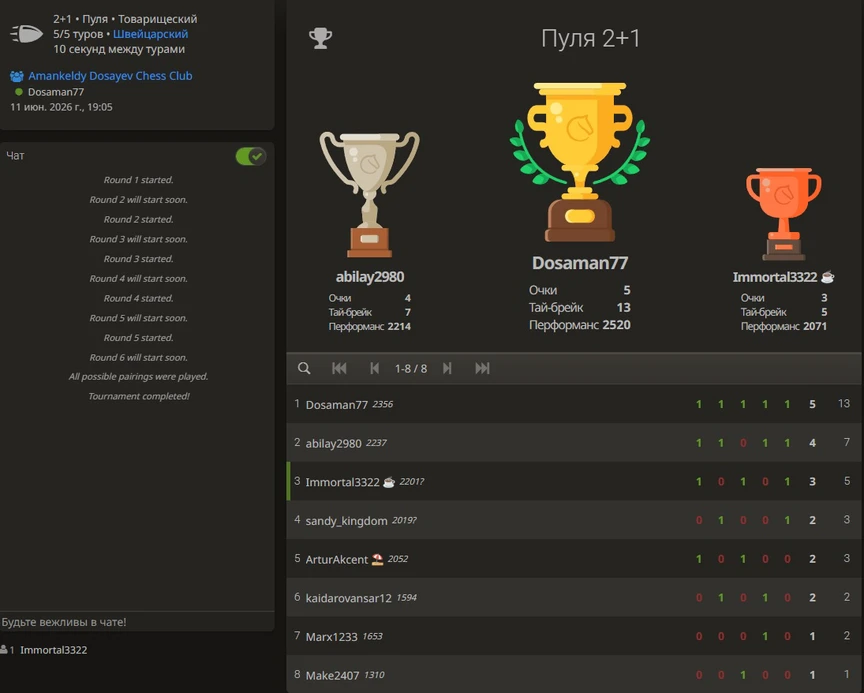
Good day, dear administrators, I would like to ask about Swiss system tournaments. A Swiss system tournament was created within the club with 9 rounds. Eight participants joined the tournament, so there should be 8 rounds. which makes sense, as that way everyone would play against everyone else. However, for some reason, the system automatically ends the tournament after the 5th round. This has happened repeatedly; I’m not sure if it’s a bug. Please look into this and provide a response. Thank you. https://lichess.org/swiss/pTwB7gRO
Good day, dear administrators, I would like to ask about Swiss system tournaments. A Swiss system tournament was created within the club with 9 rounds. Eight participants joined the tournament, so there should be 8 rounds. which makes sense, as that way everyone would play against everyone else. However, for some reason, the system automatically ends the tournament after the 5th round. This has happened repeatedly; I’m not sure if it’s a bug. Please look into this and provide a response. Thank you. https://lichess.org/swiss/pTwB7gRO

Looking at you screenshot is says "say all possible possible pairing were played" so under swiss pairing rules all games were played. Hard to to see how the algorithm should pair here. Basically people wiht sam cuo should play each other but all those have been played.
Swiss is not a round-robin. Lichess pairing use external pairing engine . For example this FIDE Dutch pairing compliant https://github.com/BieremaBoyzProgramming/bbpPairings. If you want you can dig out there on what condition all games have been played.
Looking at you screenshot is says "say all possible possible pairing were played" so under swiss pairing rules all games were played. Hard to to see how the algorithm should pair here. Basically people wiht sam cuo should play each other but all those have been played.
**Swiss is not a round-robin**. Lichess pairing use external pairing engine . For example this FIDE Dutch pairing compliant https://github.com/BieremaBoyzProgramming/bbpPairings. If you want you can dig out there on what condition all games have been played.
https://en.wikipedia.org/wiki/Swiss-system_tournament
The optimum number of swiss rounds for 8 players is 3.
I don't know if Lichess (or bbpPairings) algorithm limits the number of rounds based on the number of players or based on the results of the previous rounds ... but I am pretty sure it's not a bug.
https://en.wikipedia.org/wiki/Swiss-system_tournament
The optimum number of swiss rounds for 8 players is 3.
I don't know if Lichess (or bbpPairings) algorithm limits the number of rounds based on the number of players or based on the results of the previous rounds ... but I am pretty sure it's not a bug.
Had dig bit deeper:
Rule B.2 (The Hard Limit): No player can ever have a color difference greater than +2 or less than -2 (e.g., you cannot play 5 White games and 2 Black games).
Rule B.2 (The Streak Limit): No player can ever be assigned the same color three times in a row.
third absolute rule is : Two players cannot play each other more than once.
Absolute rules fail i.e it is. no longer possible do pairings and tournament is over.
Had dig bit deeper:
*Rule B.2* (The Hard Limit): No player can ever have a color difference greater than +2 or less than -2 (e.g., you cannot play 5 White games and 2 Black games).
*Rule B.2* (The Streak Limit): No player can ever be assigned the same color three times in a row.
third absolute rule is : Two players cannot play each other more than once.
Absolute rules fail i.e it is. no longer possible do pairings and tournament is over.
It's a bit more complicated than that, actually. Basic rules for Swiss Systems state that
-
For each participant the difference between the number of rounds they play with Black and the number of rounds they play with White shall not be greater than 2 or less than -2. Each pairing system may have exceptions to this rule.
-
No participants shall receive the same colour three times in a row. Each pairing system may have exceptions to this rule.
This is even more relaxed than it used to be in previous version (valid until Ferbruary 2026) where exceptions were only allowed in last round. In particular, Duch system (the most commonly used) has this exception:
2.1.3 [C3] Non-topscorers (see Article 1.8) with the same absolute colour preference (see Article 1.7.1) shall not meet (see the Basic Rules for Swiss, Articles 6 and 7).
Here a topscorer is a player whose score is more than 50% of maximum possible when pairing the final round and absolute colour preference means that either the difference between number of games played with white and black is higher than one (in absolute value) or the player played last two games with the same colour.
In other words, it is possible to break absolute colour preference in last round under some conditions if pairing is impossible otherwise. In practice, a player would either get the same colour in last three games or have the difference of three between the number of games played with white and black. But it's rare in normal tournaments where the number of rounds is not too high relative to the number of players.
It's a bit more complicated than that, actually. [Basic rules for Swiss Systems](https://handbook.fide.com/chapter/C0401202507) state that
> 6. For each participant the difference between the number of rounds they play with Black and the number of rounds they play with White shall not be greater than 2 or less than -2. **Each pairing system may have exceptions to this rule.**
>
> 7. No participants shall receive the same colour three times in a row. **Each pairing system may have exceptions to this rule.**
This is even more relaxed than it used to be in previous version (valid until Ferbruary 2026) where exceptions were only allowed in last round. In particular, [Duch system](https://handbook.fide.com/chapter/C0403202602) (the most commonly used) has this exception:
> 2.1.3 [C3] Non-topscorers (see Article 1.8) with the same absolute colour preference (see Article 1.7.1) shall not meet (see the Basic Rules for Swiss, Articles 6 and 7).
Here a *topscorer* is a player whose score is more than 50% of maximum possible when pairing the final round and *absolute colour preference* means that either the difference between number of games played with white and black is higher than one (in absolute value) or the player played last two games with the same colour.
In other words, it is possible to break absolute colour preference in last round under some conditions if pairing is impossible otherwise. In practice, a player would either get the same colour in last three games or have the difference of three between the number of games played with white and black. But it's rare in normal tournaments where the number of rounds is not too high relative to the number of players.
In this particular case, colour preferences do not even play any role, the rule that two players cannot play against each other more than once is sufficient to show that there is no valid pairing for round 6. As there are no unplayed games, after 5 rounds everyone has only two possible opponents left. When you number players by their (final) ranks, 2 can only play against 4 and 6, 4 can only play against 2 and 6 and 6 can only play against 2 and 4. In other words, the triplet 2-4-6 can only be paired among themselves. But you can only make one pairing out of these three and there is noone left the third could be paired with.
In this particular case, colour preferences do not even play any role, the rule that two players cannot play against each other more than once is sufficient to show that there is no valid pairing for round 6. As there are no unplayed games, after 5 rounds everyone has only two possible opponents left. When you number players by their (final) ranks, 2 can only play against 4 and 6, 4 can only play against 2 and 6 and 6 can only play against 2 and 4. In other words, the triplet 2-4-6 can only be paired among themselves. But you can only make one pairing out of these three and there is noone left the third could be paired with.
Thanks everyone for helping me figure this out. It's a shame there aren't any round-robin tournaments for these types of situations. Sorry if I'm wrong, I'm using Google Translate.
Thanks everyone for helping me figure this out. It's a shame there aren't any round-robin tournaments for these types of situations. Sorry if I'm wrong, I'm using Google Translate.
Round robin just does not work online. Even swiss only almost works. In real world people travel to venue to attend. If they lose game they will not just walk away. In very fast game tournament like yours there is better chance that people would play but in general round robin does not work unless you have some very dedicated set of people/teams that play,
Round robin just does not work online. Even swiss only almost works. In real world people travel to venue to attend. If they lose game they will not just walk away. In very fast game tournament like yours there is better chance that people would play but in general round robin does not work unless you have some very dedicated set of people/teams that play,
I remember in the early chess server days (I'm talking about the 1990s) players would be penalised for leaving a tournament without finishing it. They would earn "disrupter points" and find themselves unable to play in tournaments any more if they persisted. That way the tournaments were full of more dedicated players who played to the end, Swiss tournaments were easier to hold, and Round Robins were possible.
Of course times have changed, and playing games on the internet has become a more casual affair than it was. Drop in to play, maybe a round or even two of a tournament, then log off and do something else. It's the modern mentality. :-) So I don't think Lichess would do well to start penalising players for leaving tournaments early nowadays.
Back in those days I remember we had to be very careful organising Swiss and Round Robin tournaments, and not to start them at all if there weren't plenty of players. (They weren't fully automatic back then, and a human manager was needed online at all times for each tournament in progress.) Some players did leave early despite the disrupter points, and Swiss tournaments would actually be aborted without a result (rather than just ended early) if no more pairings could be made. No winner, lots of disappointed and frustrated players, and a very unpopular tournament manager!
I remember in the early chess server days (I'm talking about the 1990s) players would be penalised for leaving a tournament without finishing it. They would earn "disrupter points" and find themselves unable to play in tournaments any more if they persisted. That way the tournaments were full of more dedicated players who played to the end, Swiss tournaments were easier to hold, and Round Robins were possible.
Of course times have changed, and playing games on the internet has become a more casual affair than it was. Drop in to play, maybe a round or even two of a tournament, then log off and do something else. It's the modern mentality. :-) So I don't think Lichess would do well to start penalising players for leaving tournaments early nowadays.
Back in those days I remember we had to be very careful organising Swiss and Round Robin tournaments, and not to start them at all if there weren't *plenty* of players. (They weren't fully automatic back then, and a human manager was needed online at all times for each tournament in progress.) Some players did leave early despite the disrupter points, and Swiss tournaments would actually be aborted without a result (rather than just ended early) if no more pairings could be made. No winner, lots of disappointed and frustrated players, and a very unpopular tournament manager!


