
Fastest Stalemate Ever?! Genius Composition by Sam Loyd
Have you ever wondered what is the fastest stalemate in chess? Well, here it is, and it is a brilliant discovery by American Sam Loyd.
Intro - Stalemate
Stalemate in chess is the result when a player, when they are to move, has no legal moves to make, but they are not in check. If they are in check, this would result in checkmate, but if they are not in check, this is known as stalemate. The game ends in a draw and each player earns 1/2 point.
You are most likely to encounter stalemates in endgames. Many stalemates occur in king and pawn endgames where the defending side successfully blocks the pawn from promoting, and the resulting position is very common: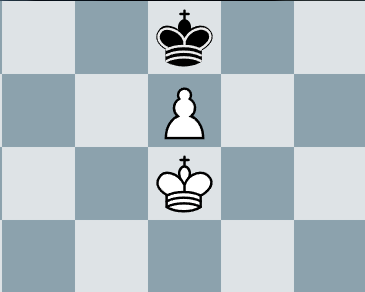
Other stalemates can occur due to a lack of care by the winning side, and they may accidentally stalemate the opposing king. Here is an example, where white tries to continue the famous technique of keeping the queen a knight's distance away but ends us stalemating:
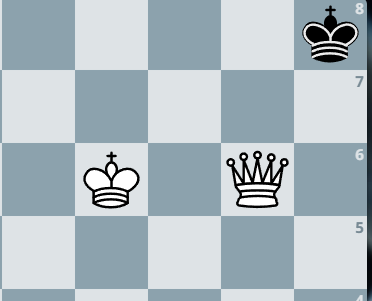
In other instances, players may cleverly set up a situation in which they self-stalemate. That is, they voluntarily trap their own king in order to save a lost position. Some of these examples have been covered in my previous blog posts, so do take a look at them if possible.
Sam Loyd's Composition
Now, we come to the question: What is the fastest stalemate possible in chess? Naturally, this leads to the idea of self-stalemate where one side tries to intentionally block in their pieces.
I have attached the game for you to look at below, which includes annotations and comments for your understanding. Ignore the evaluation and analysis, as the objective for this is not to win, but to achieve a stalemate.
Just to amuse you, here is the computer graph of this game. Now of course, this is a composition, and while there are actual games that have been played, these of course have been pre planned and are therefore completely intentional.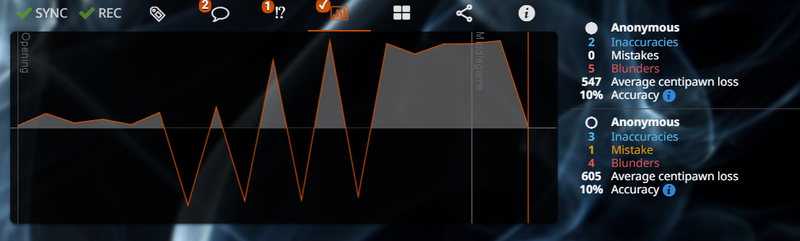
As they say: chess, when played perfectly, is a draw.
Conclusion
I hope this was an exciting thought-provoking concept for you all. See you in the next blog!
You may also like
 ChessMonitor_Stats
Where do Grandmasters play Chess? - Lichess vs. Chess.com
This is the first large-scale analysis of Grandmaster activity across Chess.com and Lichess from 200… BigBrainChess_08
Timeout vs. Insufficient Material - A Deeper Dive
Learn more about this rule that is not only confusing at times but also very controversial. BigBrainChess_08
Mathematics in Chess - Combinatorics
Maths and chess are very interwoven, and there are several examples of this. Learn about one such ex… BigBrainChess_08
Beautiful Puzzles/Studies #5 - A Genius Endgame Save!
Learn how to solve this incredible puzzle when it looks like all hope is lost! thibault
How I started building Lichess
I get this question sometimes. How did you decide to make a chess server? The truth is, I didn't. TotalNoob69