
Timeout vs. Insufficient Material - A Deeper Dive

Introduction
In chess, timing out (or flagging) is a situation where your clock runs down to 0. In virtually all cases this means you lose the game on time.
You should also know that there are certain scenarios where a player could have material that is insufficient to mate. For example, a King + Bishop vs. King is a draw as the stronger side cannot checkmate with a lone bishop.
If we combine these two, we get the scenario where one player flags, but the other player does not have sufficient mating material. In most instances this would cause the game to end in a draw by timeout vs. insufficient material. For example, if White has a King and a Bishop vs. Black's lone king and White flags, the game would be declared a draw (and the same would apply the other way around).
The Conflicting Ideas
Now, the interpretation of insufficient material can vary greatly, and there have been several controversies and instances regarding this issue.
According to FIDE --- the International Chess Federation --- should the player who did not flag have the possibility to execute a possible checkmate with the material they have, no matter how absurd or horrendous the other side would have to play to make it happen, the player who flagged in fact loses the game.
According to USCF --- the US Chess Federation -- if one player flags and the other player has material that cannot execute a checkmate by force, it is a draw. This often means having just a bishop or just a knight, as checkmate is not possible against a lone king. This is what is meant by sufficient mating material: a lone bishop and a lone knight are not sufficient mating material because they cannot force checkmate. To clarify, you actually need to be able to force checkmate with your own pieces, not with the help of your opponent's pieces (which is what I was hinting at earlier). All the other pieces are sufficient mating material (even the pawn, because it can promote).
Let's break this down:
White has a King and a Knight, and Black has a King and a Rook (no pawns for both sides). This is a theoretical draw in most cases just to let you know (we can cover this imbalance in a future blog). It is clear that if White flags, Black wins --- they have a Rook which is clearly sufficient mating material, and if anyone is playing for a win under normal circumstances it is Black.
However, the big controversy is if Black flags. Does White win, or is the game declared a draw?
FIDE's Take
FIDE will declare this scenario a win for white, and I'll explain why. Based on the scenario, there is a possibility for white to give checkmate. It does require some horrendous play by black, meaning that white needs black's cooperation, but still a checkmate is possible. This position for example is checkmate: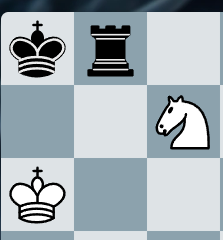
USCF's Take
USCF will declare this a draw, because White's lone knight is not sufficient to force a checkmate, similar to how without the black rook, this position is declared a draw. It doesn't matter that a checkmate is possible, but if White cannot force a checkmate, then this is a draw.
Real Life Example #1
Many of you will know this instance, and it even happened on the biggest stage. In the 19th round of the 2019 World Blitz Championship, World No. 1 and 4 time world Blitz Champion (at the time) Magnus Carlsen was playing the young phenom prodigy in Alireza Firouzja. The game reached an opposite coloured bishop endgame with Firouzja up three pawns, but as is with the nature of opposite-coloured bishops, it appeared to head into a draw. Alireza, who was playing White, flagged in the following position with his turn to move: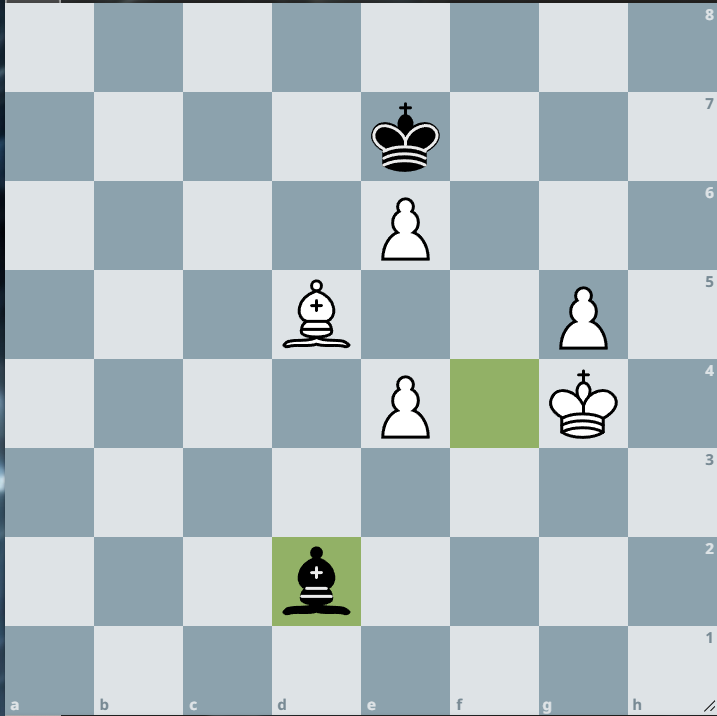
You can clearly see that Carlsen, who was playing Black, had just a lone bishop. However, when Firouzja flagged, Carlsen was given the win. Being in the World Blitz Championship, FIDE rules applied here, and they deemed that Black can give checkmate (i.e. it is possible for Black to give checkmate), even if Firouzja has to play the most horrendous moves for that to happen. One such possible checkmate can occur if Firouzja sacrificed all of his pawns, put his Bishop and King on g8 and h8 respectively, and in the meanwhile Carlsen can put his king on g6 or h6 and mate along the a1-h8 diagonal.
Therefore, given that there existed a possibility to checkmate, Firouzja lost this game. Now of course no player with the Black pieces, even a beginner (let alone a player of Firouzja's caliber) would allow this checkmate to happen, so ethically Carlsen's victory is 100% controversial. Hence Firouzja appealed but it was denied, because FIDE's rules are very clear in this case. Carlsen was given a crucial win that allowed him to set up a finals tie break with GM Hikaru Nakamura, who fell short of a maiden championship title. If Firouzja had not flagged, Hikaru would have most likely won the Blitz Championship. So, one second can make a huge difference in the world of chess --- it could mean a world title.
Real Life Example #2 - An Online Lichess Game
This next example is from the Eastern Bullet Arena played a few years ago. I watched a YouTube video by IM Eric Rosen who played in this event. He titled his video "Making Miracles" and in my opinion rightfully so. During a particular game out of these early games (where he seemed to be making miracles), he reached an endgame that was eventually lost for Eric, but since this was bullet both players were extremely low on time. This position was reached, after which Eric's opponent flagged (Eric was playing white).
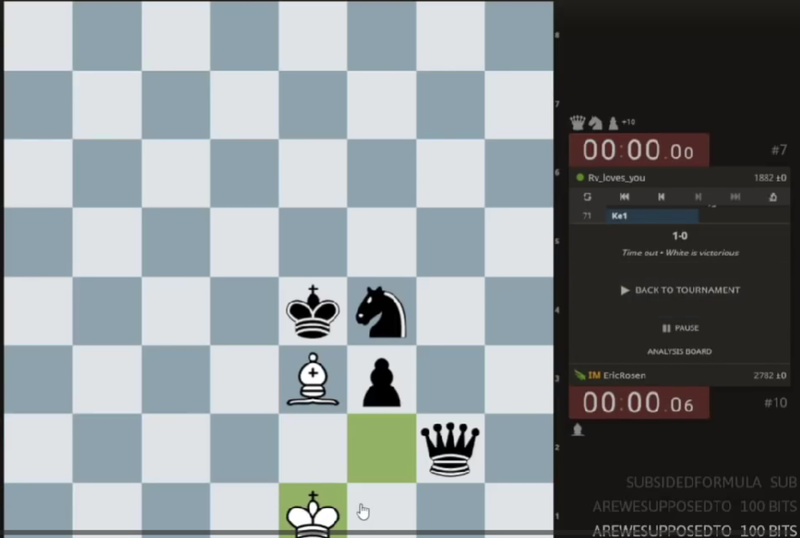
Image Credit: Eric Rosen's Video "Making Miracles | Eastern Bullet Arena" published on YouTube on 13th Feb. 2020.
Here we see that Eric has a lone bishop as opposed to Black's army. From the image you can see that black flagged and lichess declared this as a win for white. Why?
Well, based on our discussion, we realize that while a lone bishop is not sufficient mating material to force a checkmate, a checkmate is possible. For example, black has to sacrifice their pawn and queen, put the knight on g8, king on h8, and Eric's king can go to g6 (or h6) and have the bishop on g7 to deliver mate.
Here's where we come to an important point of differentiation between lichess.org and chess.com. Lichess is a French company and therefore follows the rules of FIDE. Chess.com, being an American company, primarily follows the rules of USCF. Therefore, lichess chose to declare this a win for Eric because it deemed that with the material he has a checkmate can be articulated, no matter how absurd it will be to get to that position.
Just to inform you, Eric Rosen berserked this game, meaning he voluntarily gave up half of his time (meaning he started with 30 seconds instead of 60) in hopes of gaining an extra tournament point. This was definitely a miracle considering how much of a dip his rating would have taken had he lost to someone 900 points lower. I hope you also realise that Eric had six hundredths of a second left when the flag occurred. Had Black played Qe2# or even Kxe3 in time, it is likely that they would not have lost the game (Qe2 wins on the spot but Kxe3 guarantees a draw).
Conclusion
I hope this post was instructive in breaking down this rule of timeout vs. insufficient material. We covered the differences between FIDE and USCF, and in parallel Lichess vs Chess.com in how they approach this particular rule. I have linked some resources and videos for you to take a look at for the two real world examples we discussed.
Links for Carlsen-Firouzja
This is the embedded game between Carlsen and Firouzja: https://lichess.org/broadcast/2019-world-blitz-championship-round-19/2019-world-blitz-championship-round-19/rP34Vl6L/rd6Fcmk4
This is a video by ChessBase India discussing the incident and the controversy/appeal following the game: https://www.youtube.com/watch?v=YPysTEW0YZU&t=1s
Links for Eric Rosen
This is the game:
*Note: at the final position Eric's clock shows 0. However, the clocks here cannot go to the hundredths position, but the game footage from the video shows the .06 sec that Eric had.
This is Eric's video/stream of the event, and I've made it to start a few seconds before this miracle moment.
https://youtu.be/jfHOCT2kJ0g?si=p4miS5_TLBH2GOho&t=573
You may also like
 thibault
How I started building Lichess
I get this question sometimes. How did you decide to make a chess server? The truth is, I didn't. BigBrainChess_08
Beautiful Puzzles/Studies #5 - A Genius Endgame Save!
Learn how to solve this incredible puzzle when it looks like all hope is lost! TotalNoob69
The REAL value of chess pieces
... according to Stockfish BigBrainChess_08
Queen vs Passed Pawn Part 2 - Knight Pawn
How does white win if the black pawn is a b pawn (or a g pawn)? BigBrainChess_08
Fastest Stalemate Ever?! Genius Composition by Sam Loyd
Have you ever wondered what is the fastest stalemate in chess? Well, here it is, and it is a brillia… CM HGabor