
WARNING: This Image is AI Slop (Perchance.org)
AI Slop is Invading the Chess World
Claiming that AI can teach chess is the latest fad
How do LLMs (AI Text) Work?
LLMs (Large Language Models) are models which try to simulate text which it is trained on (by predicting the next token, possibly with a element of randomness thrown in to make outputs more varied and not determined). ChatGPT is a classic example. It does this by defining a unit. A unit is the base or most primitive level of data which is analyzed. For LLMs the unit would be around 0.75 of a word on average (the words can be broken into bits), symbol characters can also be units. These units are called 'tokens'.
LLMs learn through neural nets. LLMs also contain 'parameters' which allow the output to be adjusted. ChatGPT-4 is estimated to have 1.8 trillion parameters. LLMs also require obscene amounts of data to be trained. ChatGPT-4 had to analyze one petabyte worth of data.
LLMs however are prone to making logical errors and are not able to reason well. They also collapse when given irrelevant info. Over time, the text can lose coherency and start contradicting itself.
I asked AI (from perchance.org) a simple question and it got it wrong. The following statement is true (There are never less than 32 empty squares on a chess board, as the game starts with 32 empty squares (64 squares - 32 pieces) and the amount of empty squares can only increase as pieces get removed from the board):
Q: Is this statement about chess true or false?:
There are never less than 32 empty squares on a chess board.
A: False.
A standard chess board has 64 squares. With all 32 pieces on the board (16 per player), there are 64 - 32 = 32 empty squares. However, when pieces are captured, they are removed from the board, increasing the number of empty squares. For example, after one capture, there are 31 pieces left, leaving 64 - 31 = 33 empty squares. Thus, the number of empty squares can exceed 32, but never be less than 32 (since the maximum number of pieces is 32). The statement claims "never less than 32," which is incorrect—the correct phrasing would be "never more than 32" or "at least 32."
Even though the AI says the right thing at the start, somehow it concludes the statement is false.
Also the AI contradicts itself at the end: "the correct phrasing would be "never more than 32" or "at least 32."". These are literally exact opposites.
AI Chess Marketing
AI has become quite prevalent in chess marketing. The claim is that AI could help analyze games. So they hook up ChatGPT to chess games/engines.
There are two simple tricks employed by these AI Slop Connoisseurs.
Trick 1. Train the AI so that when the player plays a move which keeps the Evaluation stable to say something generic like 'Great move, this secures your position and keeps pressure on the opponent. Keep focusing on central control and piece activity'. This creates the illusion of something actually being said. But in fact it says nothing.
----------------
Trick 2. Train the AI so that when the chess notation indicates a capture it says something like 'Nxd5 would be better as it would win material' etc. Once again this is the most basic of info. AI is not able to really assess the meat of a position or the nuances.
These two simple tricks cover the so-called 'learn with AI' hype.
Another pattern: an absurd amount of endorsements from chess personalities. One of these sites has about 20.
Having to create hype through chess personalities is a red flag for a subpar product. Trying to compensate quality with celebrity. A classic strategy.
They take advantage of the fact that beginners will not be aware that AI can not teach chess. LLMs are notorious for their confusion and false confidence.
Here's an ad from Reddit:
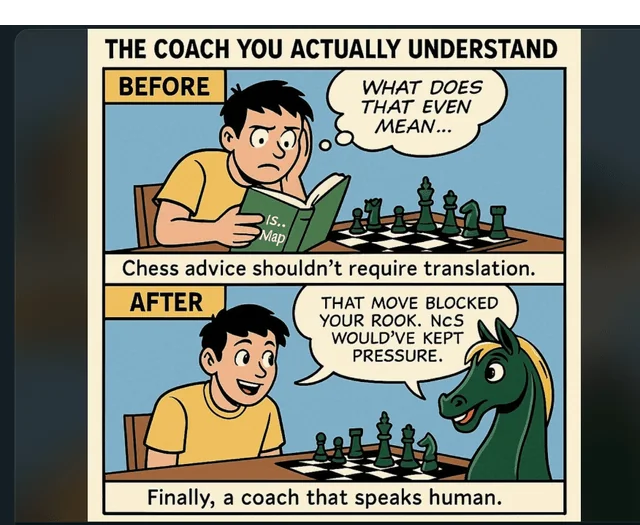 Screenshot from a reddit advert. A disgusting image:
1. The insult to chess authors claiming their chess advice 'needs translation'.
2. The AI 'advice' is the vaguest slop I've seen in my life. 'keep pressure and saying which piece attacks another piece' is not 'speaking human'.
3. The 5x5? (hard to tell XD) board.
4. The pieces are green??
5. The pieces aren't standing properly on individual squares
6. Where is the other king?
7. The disturbing (green??) horsey.
8. Why are the speech marks pointing to both of them?? (Because only the horsey is speaking).
9. Why does the book say 'Is.. Map'. What does that even mean?
There's always a murky quality to AI Images. Something off, disturbing and inhuman.
Examples from Chess AI Websites
Here are some examples of the vagueness of AI Slop. They simply cover the two tricks (Vague obvious advice like 'keep central pressure!' and stating that a 'piece attacks another piece'). This came from a Lichess Blog advertising one of these sites.
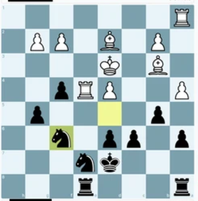
 Low quality due to screenshot from already low quality blog image.
"Nf6 doesn't actually create immediate threats"
What on earth?? Nf6 is the literal definition of an immediate threat, attacking the rook. The AI forgets whats going on in the middle of their ramble lol.
"Keep focusing on improving piece activity and maintaining central pressure in your future games."
What a stunning and penetrating insight from the AI!
Here's an claim from the person who wrote the blog and advertised their AI site:
"The platform will guide you through AI-driven questions that reveal your blind spots and decision patterns. You’ll start seeing why mistakes happen, not just where. If you analyze and review your games consistently, even once a week, you’ll start thinking like a coach reviewing your own games."
Oh dear, your screenshot seems to show the opposite! A rather embarassing faux pas ;)
"That’s how you get better faster than anyone stuck memorizing theory."
Actually I think people memorizing theory might actually get better faster than vegetating in front of painfully inaccurate and even false info from buddy AI ;)
The 2300 rated player also claimed that they use this slop themselves. Their 'premise' for the blog was that you should review your own games (true).
"That’s the difference between a normal engine check and a guided analysis. One gives you evaluation. The other rewires your thinking."
A true statement, but the blog then became incoherent as they had to force in their advertising.
Here's another example from a different website:
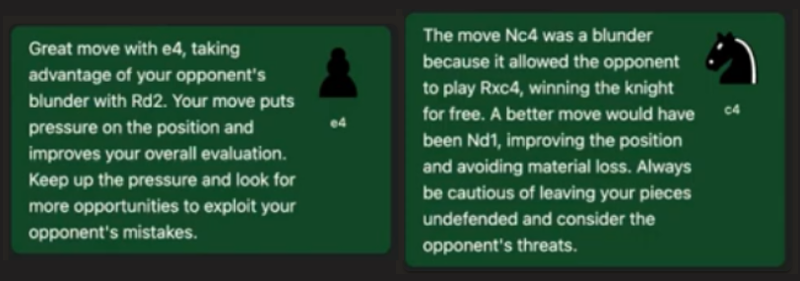
Typical slop. 'keep up the pressure', 'exploit opportunities'. Classic generic AI slop. Funny how AI writes like they're trying to hit a word count.
At best, AI will give you generic advice which could be applied to any position. At worst, it will blatantly state nonsense.
Conclusion
What is the future of chess marketing?
The AI Slop companies have risen. Right now the slop doesn't teach much. There are numerous websites with the exact same idea. They all think 'good idea, low effort for an easy product'.
Maybe it will actually teach something in the future.
Then the coaches will become obsolete. And the books and the courses. Cause the AI will be able to give you all the information. AI training data was the greatest theft, the human effort stolen to make AI outputs.
They'll siphon the chess knowledge from others to make an AI brew. Then the brew will be unleashed, drowning the chess world in AI slop for all time.
---
Visit Blog Creators Hangout for more featured blogs.
Gambling Companies are Targeting the Chess World
You may also like
 ChessMonitor_Stats
Where do Grandmasters play Chess? - Lichess vs. Chess.com
This is the first large-scale analysis of Grandmaster activity across Chess.com and Lichess from 200… RuyLopez1000
Does Stockfish Dream of Electric Knights?
Could Stockfish be Conscious? RuyLopez1000
Hourly Rapid Arena - 4th Place!
My Hourly Rapid Arena Adventure. thibault
How I started building Lichess
I get this question sometimes. How did you decide to make a chess server? The truth is, I didn't. RuyLopez1000
Fischer vs Karpov: The Match That Never Was
Explore one of the Greatest Potential Rivalries in the History of Chess GM Avetik_ChessMood