
Tim van Cleef
Rules Are Boring
"A little nonsense now and then is relished by the wisest men." - Horace Walpole
As always, opinions are my own, not those of Lichess.org.
How can disputes between players be resolved?
- Negotiate with other player(s) until an equitable solution is reached.
- In advance, players agree to arbitration by a third party (which in some cases could be a rules-following automaton).
- Appeal to an authority to compel by force, or to popular opinion to coerce other player(s) and/or an authority.
How can authority figures build respectful communities?
- Control access to resources, so only community members are capable of causing disputes or so players have incentives to not cause disputes.
- Promulgate fair rules and rely on virtuous people to collectively regulate their own behavior.
As a former leader of the Hans Niemann Fan Club team, I am aware that some rules can be overly strict.
As designer of Lichess' timeout rules (a player who according to an imperfect automaton "cannot be checkmated" cannot lose by timeout), I am aware that rules reforms often trade one category of consequences for another.
As designer of Lichess' leaderboard rules (players need a firmly established rating), I am aware that simple rules reforms can have overwhelmingly positive results (reducing forum complaints while also easing detection of possible cheaters). Even so, as sites grow so too do their Terms of Service in ways which resist reform... more on this later.
I am also aware that authorities can reach popular yet puzzling conclusions. Remind me...
- What happened when Roman Catholics brought Galileo to court?
- What happened in United States v. Microsoft Corp. 2001?
- What happened in Citizens United v. Federal Election Commission?
- What happened in Google LLC v. Oracle America, Inc.?
I imagine that ideally, growing a respectful community favors having principled, equitable rules which the community consent to follow. For example, many gaming sites have online "fair play" rules which disallow using external assistance... but can such rules be equitably enforced? Certainly, most players don't want to waste their time playing against a known disreputable opponent, and many event organizers have incentives to penalize disreputable players. However, hypothetically, having unclear rules which are not equitably enforced may generate confusion...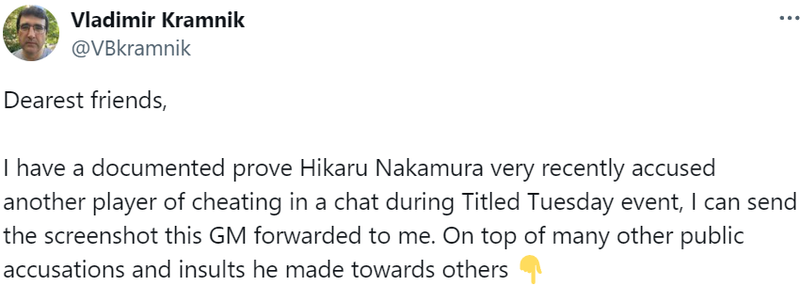
Have we been thinking about online "fair play" in an unprincipled way? Why is it that we care whether players receive external assistance?
- "It's not fair."
But why -- what exactly does that mean?
- Players have spent time and effort learning to play skillfully, and prefer to test their skill against their opponents' skills (as far as they know).
- Event organizers have incentives to prefer to promote popular events, and it is often unpopular to allow players to use assistance.
- Community leaders have incentives to prefer that event organizers to promote their community.
I'll immediately break here to note that there are obvious exceptions to these preferences:
- Often we help new players as they are learning the game, so they can enjoy the game without feeling overwhelmed.
- In social gatherings, it can be entertaining to help players. I hear that this effect can be even more pronounced in xiangqi (Chinese chess), perhaps owing to the game's difficulty.
I'll also note some other oddities:
- During Scrabble tournaments, players are required to, "When drawing tiles, show the open palm of your drawing hand to your opponent, raise the tile bag above eye level, hold the bag where s/he can see it but not between you and your opponent, look away from the bag, draw tiles and place them either facedown on the table or onto your rack."
- During chess tournaments, players are allowed to claim a draw by writing down the move on their scoresheet which produces threfold repetition, stopping the clock, and making the claim to an arbiter. However, actually playing the repetition move on the board voids this claim, even if the player does not complete their move by pressing the clock. Under US Chess rules, players are allowed to use MonRoi electronic devices to take notation, however rule 15A requires that the move be played on the board before recording it, so a player cannot use an electronic device to make a threefold repetition claim.
- During chess tournaments, a player whose time expires with king and center file pawn versus king and bishop (or knight) loses, because a checkmate is possible. However, if prior to time expiring the pawn is promoted to a queen, the game would be drawn because a checkmate is no longer possible. Nobody's going to underpromote a pawn, and yet the possibility exists.
- During chess tournaments, "If the player moves a pawn to the last rank and presses the clock without replacing the pawn with a promotion piece... the pawn shall be replaced by a queen of the same color as the pawn... If a promotion piece is not readily available, the player must stop the clocks and ask the arbiter for assistance." There is no explicit rule preventing an opponent from concealing a captured queen.
So what's my point? There are many rules, and few players are thoroughly familiar with them. And while some of that unfamiliarity can be attributed to laziness or ignorance, there aren't many incentives to learn the rules either:
- Rules infractions tend not to have catastrophic consequences (e.g., aborting too many games results in a timeout).
- Because rules are challenging to apply both consistently and equitably, organizations prefer to write ambiguous rules which can be applied at administrators' sole discretion.
- Rules frequently go unenforced (or may be unenforceable), for example:
"Cheating accusations - The public accusation of a player suspected of cheating is not tolerated." (Forums are replete with accusatory questions.)
"Sandbagging - This is where a rating is artificially deflated..." (There exists a "Go Berserk" button which tends to deflate ratings.)
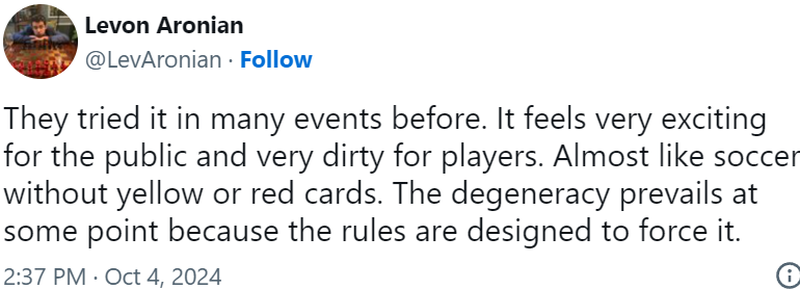
"Impersonation - This is when a user pretends to be someone else..." (It's not hard to find usernames in violation of this.) - EDIT 2024-10-5: Rules are increasingly trending toward making chess a game for spectators and not for players... Aronian comments about zero-increment chess, even when there isn't blood on the clock:
... so the task of building a unified community with shared values (beyond simply "Lichess good, Chess.com bad") seems difficult. Moderators can't moderate every action taken by an ever-increasing number of users, and site rules become incomprehensible while the codebase grows. Since 2020 my own code contributions severely decreased since there were fewer simple issues of interest to me. Even today... obvious issues are complex (such as, "Do we need so many complex rules about ratings morality and rating refunds?") and have no bureaucrat to appeal to, even while easily refutable misinformation spreads ("Lichess.org uses the Glicko 2 system.").
Having un-enforced rules isn't much better than having no rules (relevant xkcd: Elevator Inspection):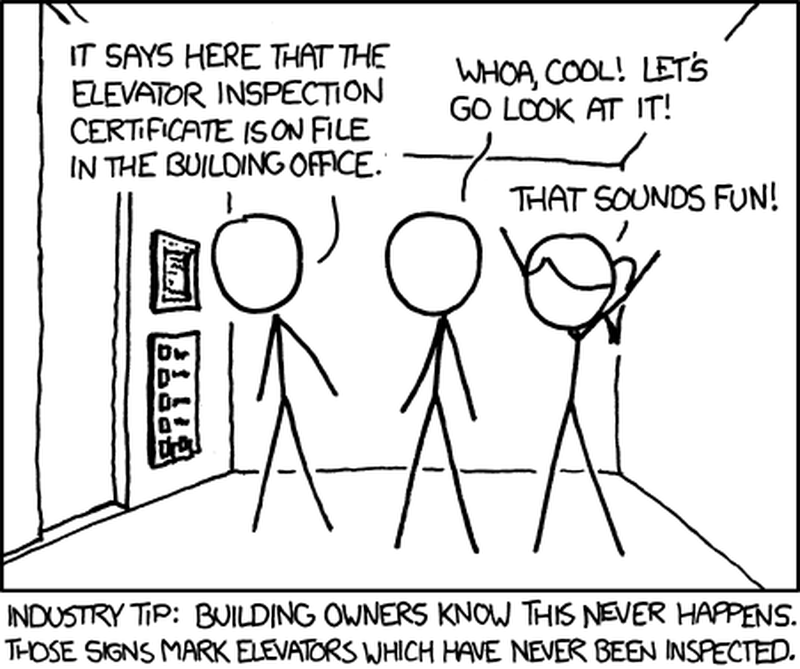
When I started writing this blog post, I naively hoped to be able to write unique insights at length about how engineers tackle complex, ill-defined issues, making the world a better place. But engineers rely on their tools, and we don't have tools which can solve social problems; we can't easily solve ill-defined problems without first clearly defining them, and as communities grow it becomes harder to clearly define anything.
I'm grateful that Lichess is libre/free software so that someday we may learn a more scalable way of making software, although it is quite good.
Image credit: Tim van Cleef
You may also like
 Lichess
Should I report this?
Ever encountered a user misbehaving on Lichess? Check out if and how to report them. Toadofsky
April 2026 State of Online Chess
Do players need more resources and innovations? WFM fla2021
Bishop or Knight? Which one to choose?
In this blog post, I want to show you some practical examples to help you understand when a bishop i… Toadofsky
Hope Chess Is Better Than Hopeless Chess
"Only the player with the initiative has the right to attack." - Wilhelm Steinitz Toadofsky
Ratings Science is Hard
How do you eat an elephant? One bite at a time. IM nikhildixit