
Exploring the Narrative Arcs of Chess Games
Using engine evaluations to find representative story arcs from a player’s history.As I mentioned in my post-game analysis checklist, I like to think about the narrative arc of chess games. There is something to learn here about psychology and time management and a slew of other topics. But also, I think it adds to the aesthetic pleasure of chess. An arresting narrative makes a good game great.
 Narrative arcs of DrNykterstein in bullet
At a high level, I am interested in whether a narrative arc repeats throughout a player’s history. For example, does that player tend to build an advantage only to throw it away in the endgame? Or do they often take a hit in the opening but roar back in the middlegame?
I am also interested in upswings and downswings. Do they happen often? When do they happen the most? Drilling down to the level of individual games might be helpful to figure out what kinds of positions trigger these swings.
Gentle staircases are worthy of note as well—typical in classical games. These imply that one player is being outplayed move after move. This kind of narrative is likely to inform the post-game analysis. Instead of looking for blunders, it would make sense to look at the strategic ideas in the position and to try to figure out how the player was consistently outplayed.
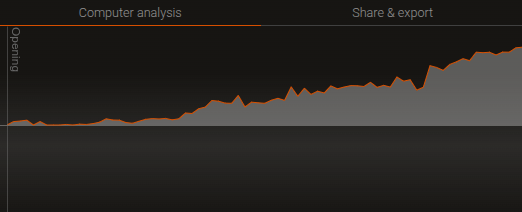 A gentle climb where Black is being outplayed
The Method
I explored this using k-medoids clustering. This method is about finding clusters in the data where the center of each cluster is an actual datapoint in the dataset. In other words, I am finding the games with the most representative narrative arcs.
Here is the protocol:
1. Define the narrative as the objective engine evaluation move to move.
2. Download all the games of a user (with computer analysis) from Lichess.
3. Extract the sequence of evaluations move to move.
4. Normalize the sequences to control for length.
5. Run a 5-medoids clustering analysis.
6. Graph the 5 medoids (games) and a few of their closest matches.
The Notebook
You can see an example of the result in the image above. And you can have a play yourself in this Colab notebook. You can substitute your username and see what you get.
 The parameters of the notebook
Outro
It’s a bit difficult to put into words what can be learned from this kind of analysis. Or rather, the learnings will vary from player to player. Repeating narratives can point to strengths to celebrate or weaknesses to work on.
I think this is one additional tool to inform a more qualitative analysis of a player’s games.
You may also like
 matstc
Review Your Best Games of 2025
A tool to view your most accurate games. thibault
How I started building Lichess
I get this question sometimes. How did you decide to make a chess server? The truth is, I didn't. matstc
My Post-Game Analysis Checklist
A method that has served me well for reviewing games. matstc
A Chess Metric: Ease (for Humans)
“I know the engine evaluation but how easy to play is this position, really?” CM HGabor