
Photo by ClickerHappy
Training Counting Material
A way to count material when doing puzzles or evaluating positions.I was intrigued by the tactics category of counting and started thinking about what other categories we might be missing out on. I suspect I’ll keep thinking about that for a while but I did think about a subcategory of counting that could be trained.
When solving puzzles, I find myself asking questions like: “if I win a knight, a bishop and a pawn but lose a rook, how does that leave me?“
Importantly, I sometimes get the answer wrong.
I don’t particularly like to do this kind of math using points of material. It does make it easier but I think the specifics of the material imbalance matter. So a more helpful representation for the question above would be:
+ knight + bishop + pawn - rook = up a minor piece and a pawn but down the exchange
The answer is always in the form of “up X but down Y” unless there is no X or no Y, in which case it’s just “up X” or “down Y”.
(Note: I try to use the terms “minor piece” and “exchange” only on the right-hand side of these equations. The left-hand side remains as specific as possible.)
Using material points, the equation above would be:
+ 3 + 3 + 1 - 5 = 2
Which I find far less helpful. As already mentioned, I am interested in the specifics of the imbalance so I do not want to use points.
This form of counting grounds me while solving a puzzle. And if I perform this counting at the very beginning, then it also helps me figure out what kind of solution I am looking for. If I start out down a queen, then I’d better win big or checkmate. But if the material starts out equal, then a more minor gain can be considered good.
Here are a few arbitrary example equations:
Example 1+ rook + pawn - bishop = up the exchange and a pawn
Example 2+ rook + queen - knight - rook = up a queen but down a minor piece
Example 3+ rook + pawn - pawn - queen + rook = up two rooks but down a queen
If you’re anything like me, confirming that the examples above are correct is not so trivial.
This could be trained!
Let’s look at a few examples with actual puzzles and then I’ll list out a few equations as exercises for the reader.
Example Puzzles
Here’s a puzzle. Black to play. Solution below.
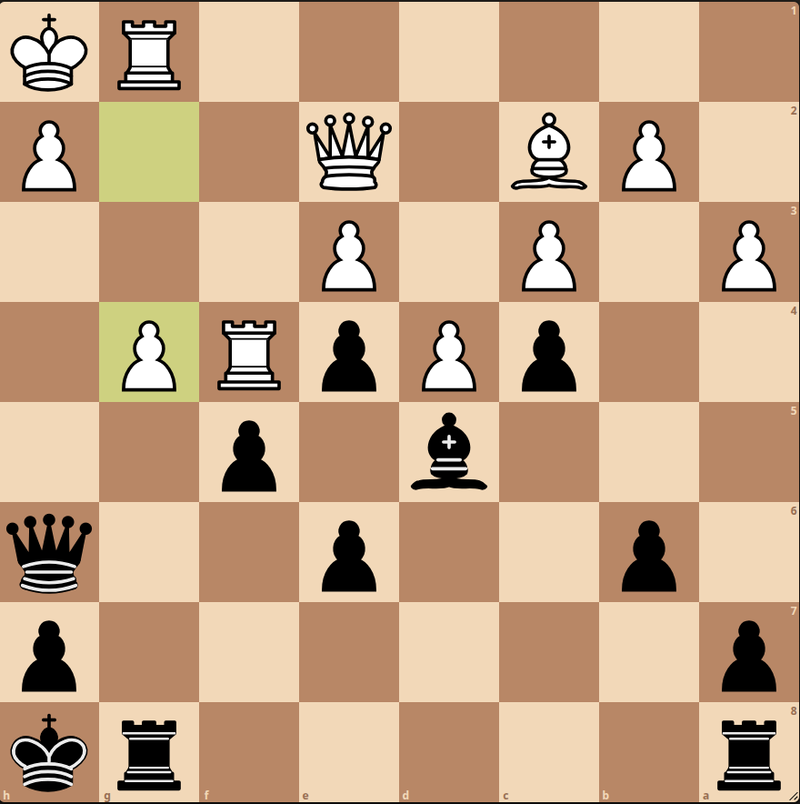
The best continuation is ...Qxf4 exf4 e3+ Rg2 Rxg4 Kg1 Rxg2+ Qxg2 Bxg2 Kxg2. But how does that leave Black? Given that the initial position has equal material, the continuation implies the following equality:
+ rook - queen + pawn + rook - rook + queen - bishop = up the exchange and a pawn
So Black is in pretty good shape after this continuation.
As another example, this puzzle has a glaring material imbalance at the very start and at the very end of the forced continuation.
White to play. Solution below.
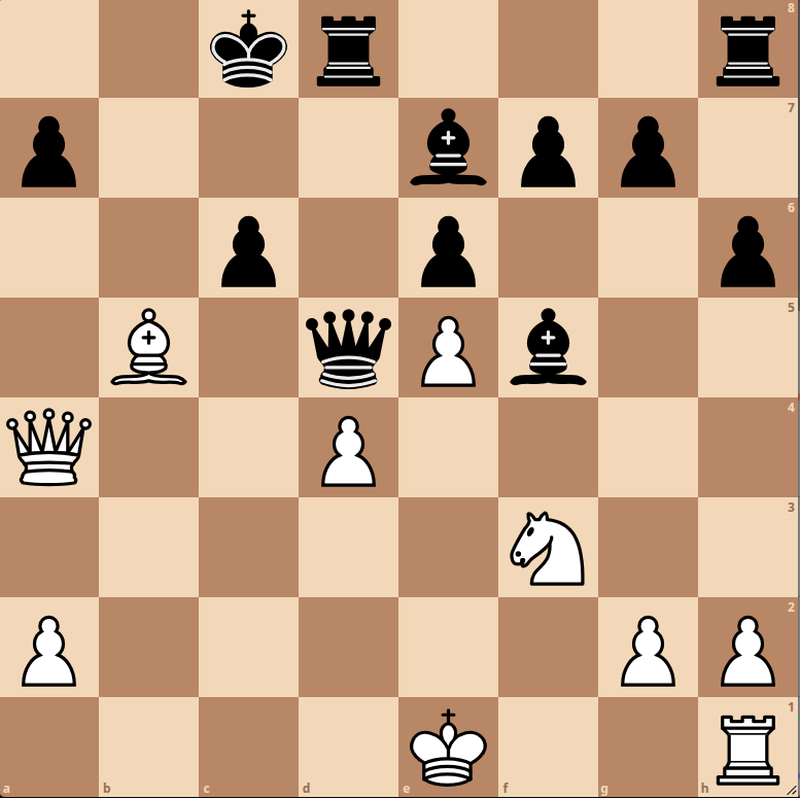
At the start, the position is down a rook and a pawn so White is not doing so well. This directs us as to what kind of solution will be considered good. For example winning a rook would not guarantee a win. After the continuation Qa6+ Kd7 (...Kb8 leads to the same equation) Qb7 Ke8 Bxc6+ Qxc6 Qxc6+, the equation yields:
(- rook - pawn) + pawn - bishop + queen = up a queen but down a rook and a minor piece
So it’s definitely worth going for that continuation for White but it won’t lead to an easy win (the computer evaluation is about +1.1).
Exercises
Here are a few disembodied equations to train the arithmetic of it, without any puzzles.
Exercise 1+ pawn - knight + pawn + pawn = ?
Exercise 2+ rook + pawn - bishop - knight - pawn = ?
Exercise 3- rook + queen - bishop - rook + knight = ?
Exercise 4+ pawn - knight + bishop - pawn = ?
Exercise 5+ rook - queen + rook - rook + queen - pawn - pawn = ?
These exercises are not that difficult but the goal is to be able to calculate quickly and accurately.
I don’t know if other people will find this technique helpful but I like to perform this kind of counting before solving a puzzle as well as at the end of my solution before I check it. Also, I find that using this technique instead of points of material leads to a better understanding of the situation on the board.


