
Find the Move: A Moment of Brilliance by Sindarov
This position comes from a high-level battle between Svane, R (2628) vs Sindarov, J (2682) played on chess.com, 2024. Before reading further, I strongly recommend you stop and think for 2–5 minutes. Black to move.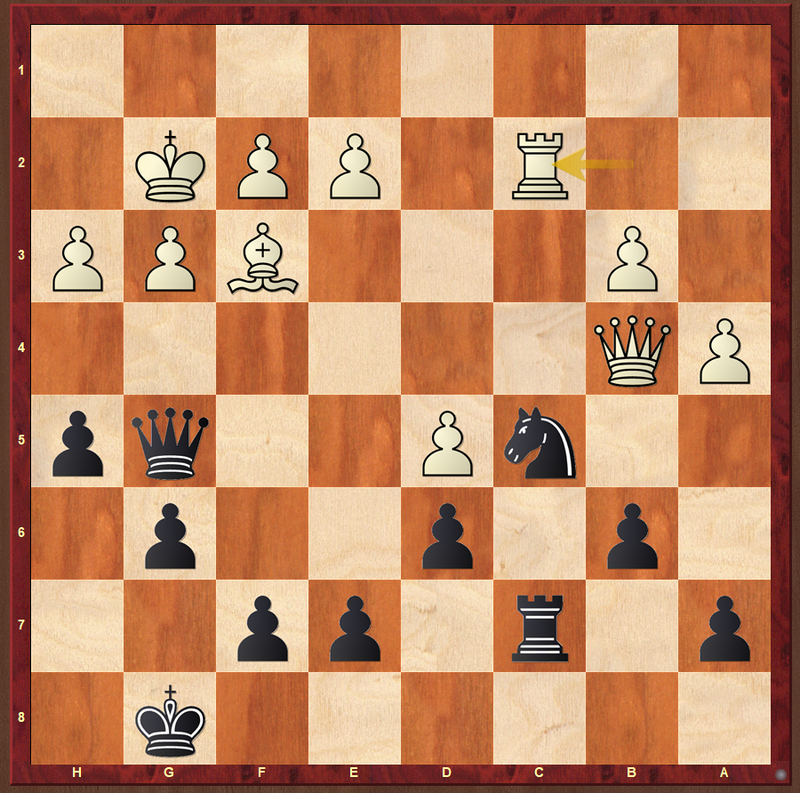
White has just played 26\. Rc2, clearly aiming to pin the knight and increase pressure.
At first glance, the move looks logical.
But strong players always ask a second question:
Is my opponent’s move really safe?
Spot the Hidden Problem
Look closely at White’s last move:
- The rook on c2 is unprotected
- Black has a knight on c5
- White’s queen on b4 is also vulnerable
Suddenly, the position starts to feel tactical.
So, what is the move that immediately jumps out?
The Flashy Shot: 26...Nd3!!
This is the kind of move that separates elite calculation from routine play.
With 26...Nd3!!, Black launches a double attack:
- The rook on c2
- The queen on b4
Both pieces are under fire, and White must find a way to save them simultaneously.
White’s Only Defense
The only move that keeps material balance is:
27\. Qd2
At first glance, it looks like White has survived.
Everything seems defended... or so it appears.
Another Level: 27...Ne1!!
Sindarov doesn’t stop there.
With 27...Ne1!!, Black renews the threats with even greater force.
Now comes the key idea:
- If Qxe1, then ...Rc2, and Black wins material immediately.
White realizes the danger and chooses the lesser evil.
The Game Continuation
Svane played:
28\. Kf1
But the pressure doesn’t ease.
Sindarov calmly continues:
28...Qd2
29\. Rd2 Rc1\!
This is the final nail.
- White cannot defend against ...Nf3
- Material loss is inevitable
- The position collapses
White resigned.
Even after 28\. Kh2, following the queen exchange, the resulting endgame is clearly better for Black.
The activity of Black’s pieces and structural advantages decide the game.
Coaching Takeaway
This position is a masterclass in punishing unprotected pieces.
White’s idea with Rc2 was conceptually correct—but tactically flawed.
Sindarov didn’t defend passively. He asked concrete questions with forcing moves:
- Nd3!! — double attack
- Ne1!! — escalation
- Rc1! — conversion
Train yourself to spot moments where your opponent’s “active” move actually creates a tactical weakness—and don’t hesitate to strike.
Youtube Link : https://youtu.be/BN4fXeX_0N0?si=BjXx4nzgugQFAaEH
You may also like
 IM NikolaN98
Top 5 Mistakes You Should Avoid in Your Games
Improvement in chess doesn’t always come from learning more openings or memorizing longer lines, it … CM Barath2000
Decision Making : Should White Play c5 Here?
Should White Play c5 Here? In this position, it is White to move Would you play c5 here? Before read… CM Barath2000
Decision Making
How Should White Recapture the Knight? The following position comes from a game played by one of my … CM Barath2000
Lou Gehrig – The Man Who Never Gave Up
Lou Gehrig was one of the greatest baseball players in history. But what made him truly special was … CM Barath2000
Opening Error
An Important Opening Detail You Should Not Miss I know this is still very early in the game—we are t… CM HGabor